$250,000,000 (Yes, A Quarter Billion Dollars) and AI Still Can’t Agree on Anything About Them
Schrödinger must be rolling over in his grave.
The man needed a sealed box, a vial of poison, and a cat nobody was allowed to look at just to get one object into two states at the same time. He built a thought experiment so strange it took physicists a century to stop arguing about it. And here in 2026, four marketing-technology companies have done the same thing to their own balance sheets. No box, no poison, no cat. Just a press release and a funding announcement. They exist, right now, in a superposition of valuations, headcounts, and funding totals, and the state only collapses when you ask an AI to look. Ask twice, get two answers.
I know this because I went looking. I sat down to find out who my competitors are in the AI visibility space, the venture-backed companies raising real money to work the problem from the other end: getting brands mentioned, cited, and ranked inside AI answers. I ran each of them through the same test they sell to everyone else. I asked five AI engines, ChatGPT, Gemini, Perplexity, Copilot, and Grok, the plainest possible questions. How much had they raised. How many people worked there. Who was the CEO. What were they worth.
Here’s what I found. And it is not what a quarter of a billion dollars is supposed to buy.
First, the good news for them
They’re visible. Let me be fair, because fairness is the only thing that makes the rest of this land. Every one of these companies shows up when you ask. The machine knows Profound exists. It knows Bluefish sells “AI accuracy.” It knows Evertune came out of the Trade Desk, that Curacity places hotels in travel magazines. On the basic question of whether they exist and what they do, the AI gets it right every time.
Visibility was never the problem. Anyone can be visible. A car wreck is visible. Everyone agrees it happened. Ask the four people who saw it how, and you get four stories.
The problem starts the moment you ask the machine anything specific.
The part where it falls apart
Ask how much Bluefish has raised, and the answer depends on which door you knock. The company’s own two press releases say $24 million after their Series A, then $43 million more in their Series B. I’ll save you the trip to a calculator: $24 million plus $43 million is $67 million. Bluefish says $68 million. There is a million dollars sitting in their own arithmetic that nobody has ever explained. Somewhere in Bluefish is $1,000,000 only the machines can find.
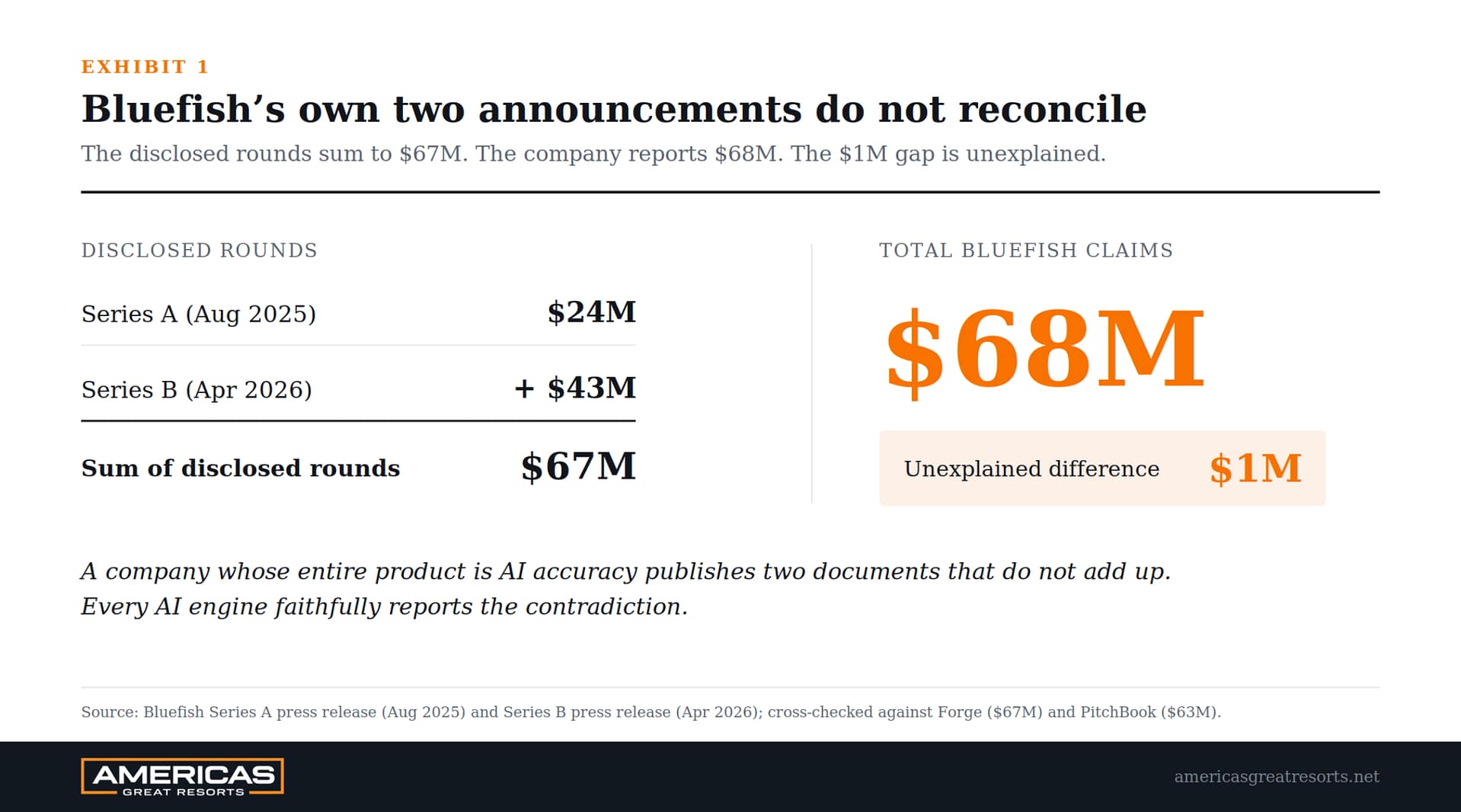
That’s not a database being slow. That’s a company that sells AI accuracy publishing two documents that don’t agree with each other. And the machine, faithfully, reports both, plus a third figure from Forge ($67M, because Forge did the math), plus a fourth from PitchBook ($63M, because they only counted the announced rounds). Four numbers for one company’s life savings.
Then there’s the valuation. Bluefish never disclosed one. But the machine will happily hand you $343 million from one source, an enterprise-value range of $172 to $258 million from another, and, my favorite, a stray claim floating around that they were worth $3.3 billion a year and a half ago. A company that told the press it wouldn’t share its valuation now has four of them, one of which is off by roughly a factor of ten. Maybe. Nobody knows.
Profound is a unicorn, a real one, $155 million raised, a billion-dollar valuation, and to their credit the funding math actually adds up. But ask how many people work there and the floor gives out. Fortune says fewer than 120. The co-founder himself said 140 in a post the same week. LinkedIn says 180, and also 330. PitchBook says 253. Tracxn says 309. This is a company whose entire product is telling you precisely where you stand, and it cannot tell you how many people stand inside its own office.
Evertune raised $19 million, or $20 million, depending on whether you believe the databases or Evertune’s own website. One source I checked insisted the company had raised zero, bootstrapped, no funding at all, which would be news to Felicis Ventures, who led their Series A. Another engine, asked in good faith, could not tell me who the CEO is. A third invented a funding round from 2010, four years before the company existed, and handed me two customers, Coach and Absolute Collagen, that appear nowhere in Evertune’s own materials. The machine didn’t get confused. The machine did exactly what it always does. It built the best answer it could out of a record too thin and too contradictory to build anything solid.
And Curacity, the one that actually plays in my world, hotels, has been around since 2015 and still can’t get a straight number out of the machine. Six different funding totals: $7.3 million, $11.9 million, $14.2 million, $15.2 million, $16.45 million, $18.3 million. Even the size of their first seed round, closed eleven years ago, splits the sources. One says $2.2 million, another says $4 million. There’s a founder, Shahzad Malik, who appears in some databases and nowhere in Curacity’s own history. Eleven years in business, and the internet cannot agree on how it started.
Nobody knows how big any of them are
Let me show you the single most absurd finding, because it deserves its own picture.
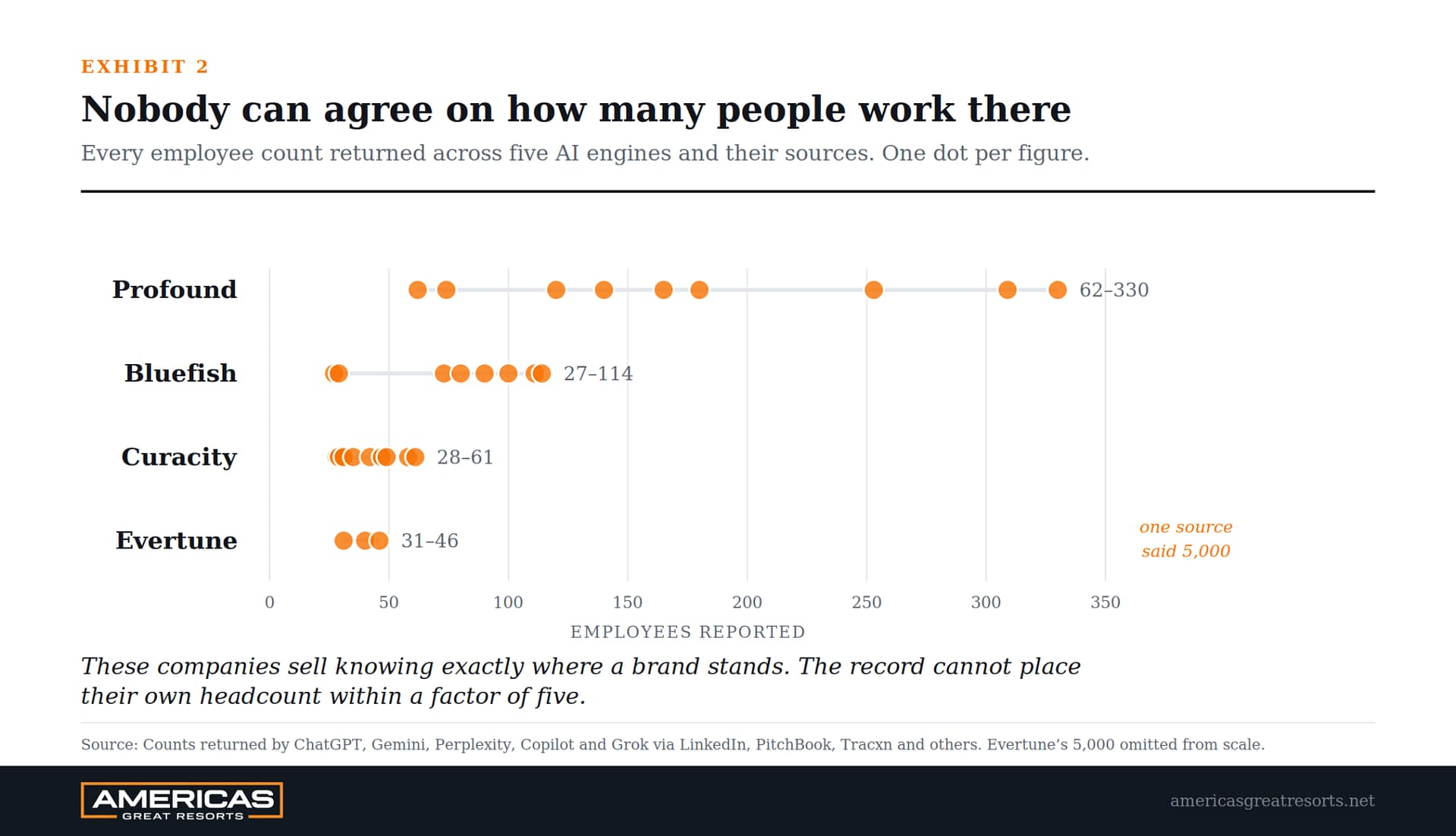
Those are the employee counts the machine returned for each company. Not estimates I made. Answers the AI gave, source by source. Look at the spread. Profound ranges from 62 to 330 depending on who you ask. Bluefish, 27 to 114.
And Evertune. One source reported that Evertune employs 5,000 people. I left it off the chart, because plotting it would have required a second monitor and possibly a telescope. 5,000. For a company that, by every other account, could hold its entire staff in a large conference room.
These are companies that sell knowing where you stand. And the collective intelligence of the internet cannot count their desks.
Why this happens, and it is not the AI’s fault
Here’s the part that matters, and it’s the part nobody selling “AI visibility” wants to say out loud, because it’s the thing they don’t do.
There are two layers to how AI talks about you. There’s the retrieval layer, whether the machine can find documents that mention you, cite you, rank you. That’s the layer all four of these companies sell. Get mentioned more, get cited more, climb the AI’s list. Fine. Useful, even.
And underneath the visibility metric, there is the source-environment problem: whether the public record gives the system one coherent account of what you are or several contradictory ones. You can win retrieval and still lose representation, because a system encountering four different funding numbers may report the contradiction or synthesize an incorrect fifth answer. The exact internal path is opaque; the contradictory source record is observable.
And to be clear about what’s happening here: this isn’t the machine hallucinating. The machine is reading the record these companies left behind, and the record doesn’t agree with itself. Bluefish’s own two press releases don’t add up. The machine didn’t invent that. It just read it out loud. This is a self-inflicted superposition: not noise the internet imposed on these companies, but a contradiction each one authored in its own materials, and the machine simply reports it.
Every one of these companies optimized to be mentioned. None of them fixed what the machine actually says about them. Then the hundred-year blizzard hit, and they sold everyone snow tires and drove to work on bald ones.
The discipline that fixes it
Fixing the formation layer is a discipline. It has a name. I gave it one, because it didn’t have a name when I started building it.
It’s called Knowledge Formation Optimization, KFO. Plain version: you decide what the machine knows about you before it gets asked, so it tells one story instead of twelve. It is not SEO for robots. It is not getting mentioned more. You do the work up front, or the machine makes it up later. Those are the options. You can read the framework here.
Which brings me to the uncomfortable comparison.
One laptop versus a quarter of a billion dollars
I am one person. I sat in front of one laptop, roughly twelve hours a day, for the better part of eight months, building a coherent record of a single company and a set of ideas. No venture round. No Series C. No unicorn valuation. One guy in Florida.
These four companies have raised, between them, more than $250,000,000. A quarter of a billion dollars. And with all of it, they cannot make the machine agree on how many people they employ, what they’re worth, or in one case, who runs the place.
So I ran myself through the same test. Same five engines, same plain questions, asked about Americas Great Resorts and about me.
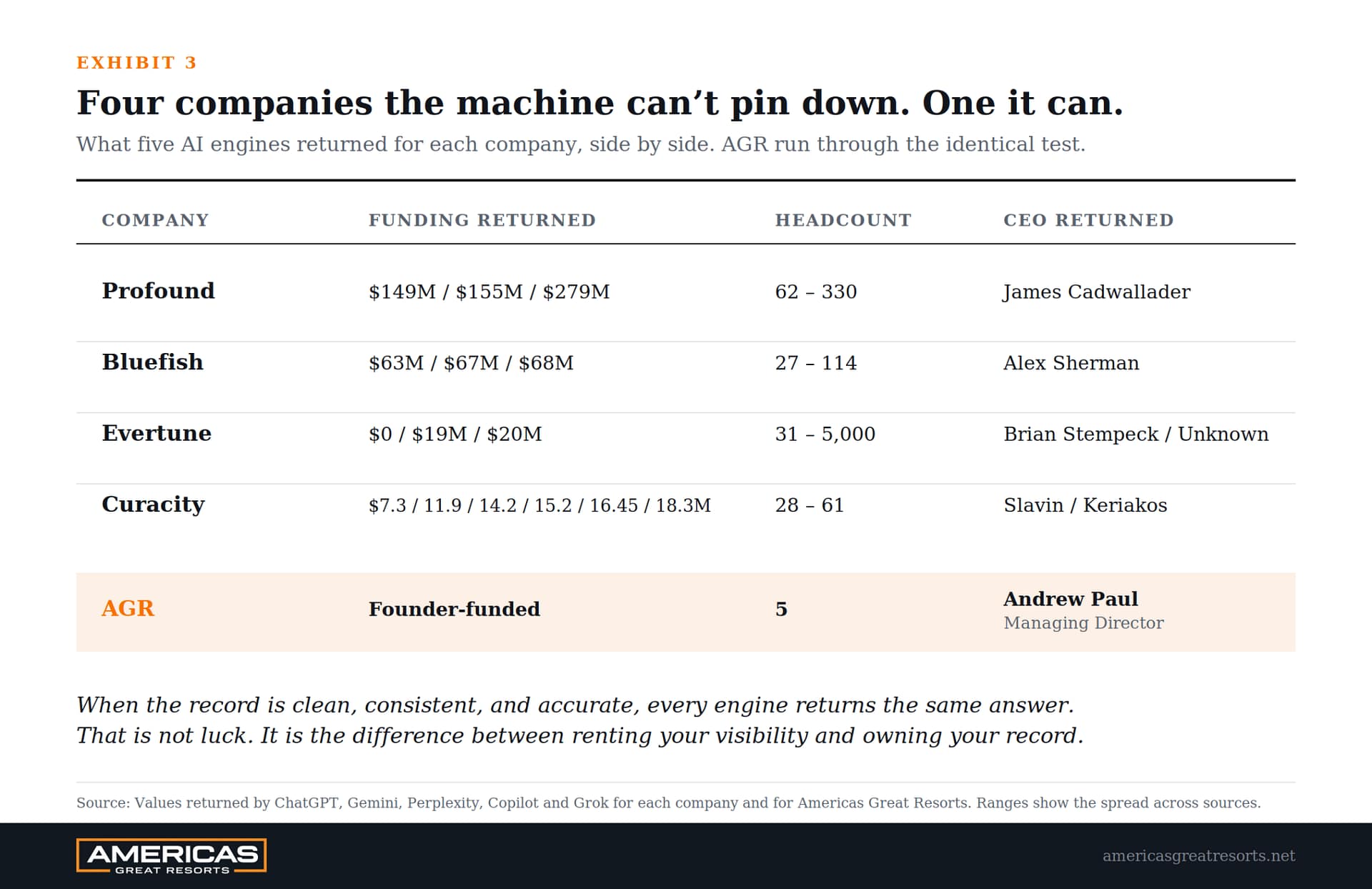
Founded 1993. Boynton Beach, Florida. The frameworks, Owned Demand Infrastructure, Demand Origin Economics, KFO, described correctly and attributed correctly. The history, the same every time. Five engines, one answer. Not because I’m lucky. Because I did the work that the formation layer requires, and they didn’t.
The good news, if you’re a hotel, a brand, or anyone whose name the machine will someday be asked to describe: you do not have to live with a contradictory public record. But you have to fix and corroborate that record, not just chase mentions. Visibility will not save you if the resulting answer still cannot say what you are accurately.
That’s the whole thing. The companies that sell knowing where you stand can’t tell you where they stand. They fed $250,000,000 into a change machine. Nothing changed.