
TLDR: GEO (generative engine optimization) for hotels is the practice of optimizing a hotel’s digital footprint, its content, structured data, listings, and third-party mentions, so AI systems like ChatGPT, Gemini, and Perplexity include and accurately describe the property in their answers. It is necessary work, and it is not the whole job. Americas Great Resorts classifies everything sold under the GEO and AI visibility banner into three functions: measurement, which shows you the problem; retrieval optimization, which tunes how AI systems deliver the picture of your hotel that already exists; and formation, which shapes that picture in the first place. Much of what is sold today covers the first two. This guide defines each function, names the tool market, shares original audit findings, and gives a 30-day starting plan, with particular attention to luxury hotels, where a lost booking can represent four figures in room revenue.
What is GEO for hotels?
GEO for hotels is the process of optimizing a hotel’s digital footprint, meaning its website content, structured data, business listings, and third-party mentions, so that generative AI platforms include and accurately describe the property in their answers to traveler questions.
Quick answer
GEO for hotels is the practice of improving a hotel’s visibility in AI-generated answers from platforms such as ChatGPT, Gemini, Claude, Perplexity, and Google’s AI features. In the Americas Great Resorts classification used on this page, hotel AI visibility work spans measurement, retrieval optimization, and public source-environment correction. GEO primarily addresses retrieval and citation. KFO addresses public source-environment correction, corroboration, and repeated output measurement.
SEO helps a hotel rank in search results. GEO can improve retrieval, citation, and visibility in AI answers. KFO addresses the broader public source environment and measures whether AI systems reproduce the hotel’s identity and positioning accurately across relevant queries and over time.
The shift driving it is measurable. A Skift Research and McKinsey survey found 30 percent of US travelers used ChatGPT or similar tools extensively for trip planning in 2025, up from 13 percent the year before. Hotel Benchmark’s AI Traffic Tracker, which aggregates analytics from hundreds of hotels, recorded AI-referred sessions to hotel websites up 581 percent year over year in April 2026, with AI-attributed revenue up 404 percent, though the same source notes absolute volumes remain small and the figures capture direct click-throughs only, not AI-influenced bookings that arrive through other channels. Gartner forecast in early 2024 that traditional search volume would fall 25 percent by 2026 as AI assistants absorb discovery. When a traveler asks an AI for the best hotel for an anniversary in your market, the machine answers with three to five names. Either you are one of them or you are not.
The Three Functions of Hotel AI Visibility
“GEO” is often used as a blanket label for every activity connected to AI visibility. That obscures three different jobs that require different methods, different deliverables, and different evidence of success.
Function 1: Measurement. Identifies whether a hotel appears, how it is described, and where booking guidance routes in AI-generated answers. Evidence of completion: a documented, repeatable baseline.
Function 2: Retrieval optimization (GEO). Improves the likelihood that AI systems retrieve and cite accurate, first-party information about the hotel at answer time. Evidence of completion: the hotel’s own facts and sources are consistently retrievable.
Function 3: Formation (KFO). Shapes the underlying representation AI systems build about the hotel before any traveler query occurs. Evidence of completion: the hotel is described consistently, in its own category and language, across systems. Knowledge Formation Optimization is Americas Great Resorts’ framework for this function.
These functions are connected, but they are not interchangeable. Measurement reveals the problem. Retrieval optimization improves access to the available information. Formation changes the body of information from which the hotel’s representation is built. The three functions map directly onto how an AI answer is produced, shown in the sequence below: formation builds the representation, retrieval pulls the material, and measurement observes the generated result.
How Are SEO, GEO, and KFO Different?
SEO, GEO, and KFO are not the three functions above; they are different scopes of optimization that operate across those functions. A hotel can rank organically without appearing in an AI answer, and it can appear in an AI answer while described generically or routed to an intermediary. The three outcomes must be measured separately:
| SEO | GEO | KFO | |
|---|---|---|---|
| Optimizes for | Ranking in a list of links | Retrieval and citation in AI answers | The AI system’s underlying representation of the property |
| Typical work | Keywords, backlinks, technical site health | Schema, FAQ content, data consistency, listing alignment | Entity definition, coordinated authoritative publication, representation monitoring and correction |
| Limit | Rankings no longer guarantee AI presence | Strengthens delivery of the existing representation | Slower to compound; maintained continuously, not achieved once |
On the SEO limit: BrightEdge research on Google AI Overviews found travel has the lowest overlap of any measured industry, 23.6 percent, between top-ten organic rankings and AI Overview citations. Ranking first and being cited in the AI answer are now separate achievements.
How AI hotel recommendations are produced
- Formation. What the system has learned your hotel is, from everything it has ingested.
- Retrieval. What information it pulls at the moment a traveler asks.
- Answer generation. How it combines representation, retrieved material, and runtime context into a recommendation.
GEO primarily affects retrieval. KFO focuses on formation. Both influence the final answer.
Modern AI systems blend these influences differently by platform and by query, and no single layer controls the outcome alone. In AGR’s model, GEO primarily addresses retrieval and citation, while KFO addresses deliberate representation formation. The practical point is simpler than the architecture: a hotel that has only ever worked the retrieval step has left the formation step to whoever else has been describing it, and in the source data examined so far, that has largely meant intermediaries.
The tool market: what measurement can and cannot do
The fastest-growing category in hotel marketing technology is AI visibility measurement, and it is worth naming honestly. Hotelrank, recently acquired by Lighthouse, runs structured traveler queries across AI platforms and published the most detailed public study of Google AI Mode hotel answers. LuxDirect monitors six platforms with a luxury-independent focus and pairs monitoring with implementation services. Operto offers a free GEO scan with recommendations. RevPARGenius tracks hospitality-specific prompts and supplies action plans. Horizontal platforms like Profound and Otterly track AI mentions across industries. Several of these providers span more than one function; the classification that matters is not the company but which function each engagement actually performs. AGR applied that classification to the vendor market in its ranking of luxury hotel AI visibility agencies, scoring 24 firms on whether their published claims can be checked before a hotel signs.
What the measurement function has documented should unsettle every owner. Hotelrank’s 2026 study of 4,000 Google AI Mode hotel queries, covering 84,000 source citations, found 79 percent of links in AI answers routed to a Google Business Profile rather than the hotel website, and content from OTAs and other intermediaries made up 46.6 percent of the source material behind the answers. A separate 2026 Google AI Mode consistency study measured average position-one stability at 50.5 percent, with wide variation by market and query, meaning the hotel ranked first in an AI answer held that position in only about half of identical repeat runs on average.
Measurement is diagnosis, and diagnosis is where improvement starts. But a report that says you are invisible does not make you visible, any more than a scale makes you lose weight. If the scan comes back bad, the question becomes which layer failed, and that is where the function classification earns its keep.
What a 300-capture audit of AI hotel recommendations found
Americas Great Resorts studies the problem at the recommendation level, not just the traffic level. In July 2026, AGR completed a 300-capture audit study spanning 25 traveler questions, covering romance, family, wellness, business, and booking-guidance intents, across ChatGPT and Gemini in six US markets (New York, Los Angeles, Chicago, Miami, Maui, and Napa Valley). Capture sessions included repeat runs in selected markets, so the study is not a single pass through every question-platform-market combination; the full capture allocation, methodology, and quantified market-level findings are being prepared for separate publication. The audit observed outputs; it did not isolate causes. Three patterns held across the captures:
- Winner-take-most concentration. In every market tested, a small set of properties dominated the answers across question types. The machine does not distribute recommendations; it consolidates them.
- Answer instability. Repeat sessions returned shifting recommendations, including within the same day, consistent with the independent consistency findings above.
- Booking guidance that bypasses the hotel. Recommendation answers frequently paired a property’s name with third-party booking guidance, meaning even hotels that win the answer can lose the margin.
These observations are consistent with the three formation failure patterns described below: concentration is what absence looks like from the outside, third-party booking guidance is intermediary dominance rendered in the answer itself, and instability often reflects weak or competing representations. The audit does not prove those causes; it documents the outcomes a hotel experiences when the layers beneath the answer are left unmanaged.
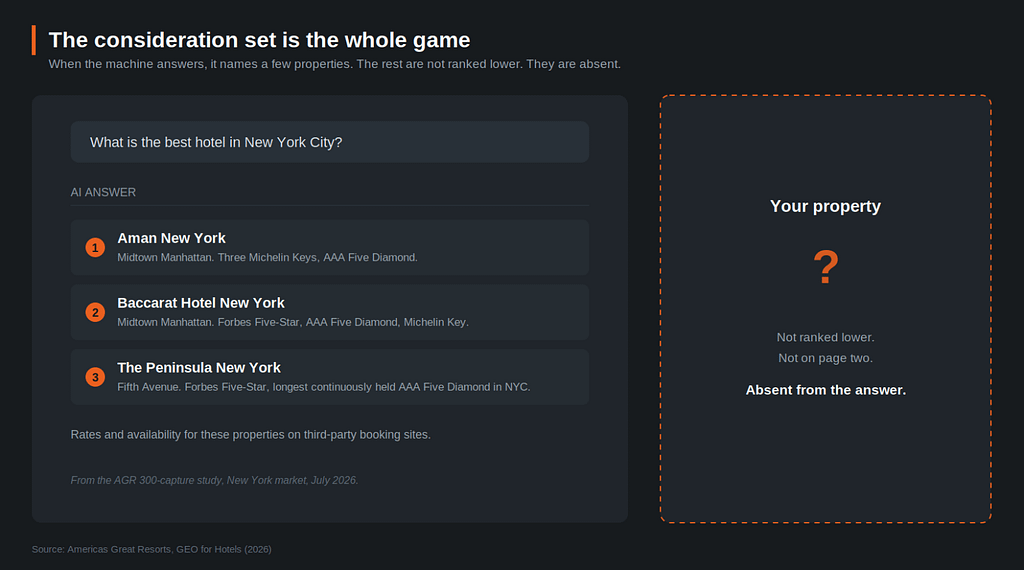
For luxury hotels, the concentration finding is the whole game. When the machine names three properties for “best hotel in Miami for an anniversary,” the properties not named have not slipped a ranking position. They are absent from the consideration set entirely, in a category where a lost booking can represent four figures in room revenue.
What GEO work actually consists of, and a 30-day starting plan
Retrieval-layer GEO is legitimate, necessary work, and any hotel can begin it immediately:
- Days 1 to 5: Baseline the current state. Run one of the measurement tools above or a structured audit, and ask ChatGPT and Gemini the questions your guests ask. For a quick first look, run AGR’s real-time AI Visibility Report, which checks ChatGPT, Gemini, and Google AI Mode. Treat single sessions as reconnaissance, not diagnosis; answers vary by session, and a fair baseline uses repeated captures.
- Days 6 to 10: Fix entity consistency. Name, address, room types, amenities, and descriptions must match across your website, Google Business Profile, and every distribution channel. Contradictions give the machine a reason to skip you.
- Days 11 to 15: Implement hotel schema properly. Structured data for the property, rooms, amenities, FAQs, and reviews in JSON-LD, with the property’s core entities defined precisely and sameAs links connecting the schema to authoritative external references for the property. Machine-readable identity, not just machine-readable facts.
- Days 16 to 19: Publish answer-shaped content. FAQ blocks written in the language travelers use: policies, occasions, accessibility, neighborhood questions. Specificity is what machines can use: “rooftop pool heated year-round, open until 10 PM” beats “world-class amenities,” and “12-minute walk to the convention center” beats “unbeatable location.”
- Days 20 to 22: Keep pages fast and crawlable. Key content visible to crawlers, not buried in JavaScript or PDFs.
- Days 23 to 27: Align existing references. Correct and strengthen the mentions of your property that already exist: listings, local tourism sources, review platforms, media coverage. In AGR’s model this alignment work is GEO; the deliberate creation of a coordinated body of new authoritative source material is formation work, covered below.
- Days 28 to 30: Re-measure and document. Position-one stability averaged 50.5 percent in the cited consistency research; a single good result guarantees nothing.
Most established hotel marketing agencies now offer this work, and the competent ones do it well. Its structural limit is what it operates on: retrieval optimization strengthens the delivery of the representation the machine already holds. The intermediary citation data is the tell. In the Google AI Mode research, nearly half the source material behind hotel answers came from intermediaries. Markup on your own website makes your material easier for machines to interpret and retrieve; it does not remove the intermediary material or guarantee that your version will be preferred.
For luxury hotels the cost of that limit is highest. A commodity property selling location and price loses little to generic description. A luxury property selling identity, atmosphere, and a specific promise loses its premium when the machine flattens it into “a nice hotel with a spa.” That flattening happens upstream of markup.
The public source environment: where the hotel record can be corrected and corroborated
Before a query is answered, a public information environment already exists around the property: first-party pages, structured data, editorial coverage, reviews, listings, and other third-party descriptions. A platform may use training data, retrieval, provider-side indexes, prompt context, or other proprietary mechanisms to produce a response. Outsiders cannot directly observe the exact internal path. What can be inspected and improved is the public source record, and what can be measured is the resulting output behavior.
You can get a preliminary signal of your representation in two minutes. Open a fresh, signed-out AI session and ask: “Describe the brand identity and guest profile of [your property] without referencing its location or price.” If what comes back is generic hospitality language that could describe any competitor, that is a signal of dilution. Treat it as a heuristic, not a diagnosis; repeat the test across sessions and platforms before drawing conclusions.
Formation-layer failure shows up in three patterns. Absence: the property does not appear for queries it should own. Intermediary dominance: the property appears, but described in language lifted from OTA listings, with booking guidance routed to third parties. Dilution: the property appears but blurred into generic category language, indistinguishable from its competitors.
KFO structures, sequences, distributes, corroborates, and corrects intellectual frameworks and entity definitions across the public information environment and measures whether AI systems reproduce them accurately across relevant queries and over time. AGR originated KFO in 2025. The current academic paper is Version 4.0, revised September 2, 2026, with version DOI 10.5281/zenodo.22264006 and concept DOI 10.5281/zenodo.20636830. For hotels, AGR applies KFO through precise entity definitions, source correction, corroboration, distribution, and repeated monitoring of observable AI outputs.
One honest caveat belongs here: recommendation outcomes are also influenced by model updates, personalization, interface design, agentic booking flows, and runtime retrieval, none of which any optimization discipline fully controls. Formation work does not guarantee the answer. It shapes what the machine has to work with when it composes one.
When GEO alone is enough
If AI systems already describe your property accurately, in your own language, prominently, with booking guidance pointing to your website, then measurement plus retrieval maintenance may genuinely be sufficient. Keep your data consistent, keep your schema current, and re-check monthly.
If what comes back is absence, someone else’s language, or generic category prose, the report in front of you is describing an upstream problem. The dashboard found it. The dashboard cannot fix it, and markup alone rarely does either.
The sequence that works
Measure first. Diagnose which failure pattern is actually present. If the evidence points to a public source-environment representation problem, correct and corroborate that record. Then optimize retrieval where appropriate and keep measuring, because AI outputs can vary by platform, query, session, and time. The 30-day plan above is a retrieval-oriented starting point; the later diagnosis determines whether deeper source-environment work is warranted.
Frequently asked questions
What is GEO for hotels?
GEO, generative engine optimization, is the practice of optimizing a hotel’s content, structured data, and third-party presence so AI platforms such as ChatGPT, Gemini, and Perplexity include and accurately describe the property in their answers.
What is the difference between GEO and SEO for hotels?
SEO targets rankings in search results; GEO targets inclusion and citation in AI-generated answers. In travel, BrightEdge measured only 23.6 percent overlap between top organic rankings and Google AI Overview citations, the lowest of any industry studied.
What is the difference between GEO and KFO?
GEO primarily focuses on visibility, retrieval, and citation within generative-answer environments. KFO structures, sequences, distributes, corroborates, and corrects intellectual frameworks and entity definitions across the public information environment and measures whether AI systems reproduce them accurately across relevant queries and over time. For hotels, that means KFO addresses the broader public source record and repeated observable representation, not a directly observed formation layer inside a proprietary model.
Do AI visibility tools improve a hotel’s AI visibility?
Measurement by itself does not; it reports the current state. Improvement requires retrieval-layer work, formation-layer work, or both. Some tool providers also offer implementation services alongside monitoring.
Why does GEO matter more for luxury hotels?
Luxury properties sell identity, and AI systems frequently describe hotels in generic, intermediary-sourced language. A commodity hotel loses little to generic description; a luxury hotel loses its premium.
Is SEO still worth doing for hotels?
Yes. SEO, GEO, and formation work are complementary, and organic visibility still drives direct revenue. But strong SEO no longer guarantees presence in AI answers.
Americas Great Resorts implements Knowledge Formation Optimization as a managed service for independent luxury hotels, resort properties, and luxury cruise lines, beginning with a structured audit of how AI systems currently represent the property.

