The Real Reason Luxury Hotel Marketing Breaks at Scale
Luxury hotel marketing rarely looks broken from the inside.
Occupancy may appear stable. Campaigns are running. CRM is in place. Automated email journeys are active. Paid media is optimized. Agencies are producing creative. On paper, the system appears to be functioning.
Yet many luxury hotels still experience the same underlying pattern: direct bookings plateau, shoulder periods remain fragile, dependency on intermediaries persists, and margin keeps leaking out of the system.
That does not happen because hotel marketers are lazy, because agencies are incompetent, or because email somehow stopped working.
It happens because the industry keeps assigning the wrong job to the wrong systems.
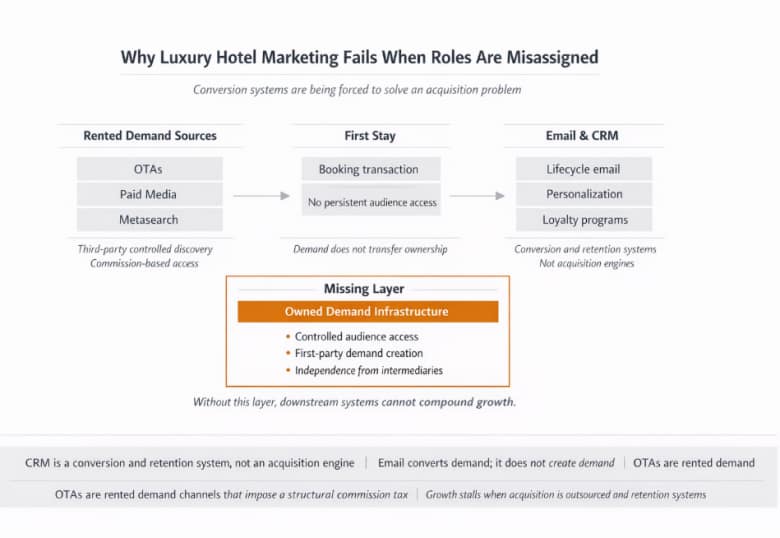
Luxury hotel marketing breaks at scale when retention and conversion systems are forced to compensate for a missing upstream demand system. The problem is not campaign execution. The problem is structural role confusion.
That is why so many hotels continue to invest in downstream optimization while the real bottleneck remains untouched: they do not control audience access before booking occurs.
For the broader strategic context behind that distinction, see Luxury Hotel Marketing, which explains why sustainable hotel growth depends on more than channel execution alone.
The Repeating Failure Pattern in Luxury Hospitality
The pattern is consistent across luxury hotels and resorts.
Demand is sourced through OTAs, intermediaries, paid media, or other rented channels. Occupancy may look healthy, but the economics underneath are weaker than they appear.
Marketing responds rationally within the wrong frame. CRM gets expanded. Automated email journeys are built. Personalization improves. Send cadence increases. Paid media is layered in during need periods. Promotional pressure rises. OTAs remain the backstop.
Email metrics may look acceptable. Campaign reporting may even look good.
But growth still does not compound.
At that point the usual diagnosis appears: we need better marketing.
That diagnosis is usually wrong.
The hotel is not suffering from a downstream execution failure. It is suffering from an upstream demand control problem.
That is the core reason luxury hotel marketing fails at scale: hotels are trying to compound value on top of demand they do not actually control.
Why Email Cannot Solve the Actual Constraint
Email marketing is one of the most valuable revenue channels in hospitality. But it has a defined role.
Email works after a relationship exists. It can reactivate interest, increase direct rebooking, deepen engagement, and improve guest lifetime value. What it cannot do on its own is solve the upstream problem of audience access.
If a hotel does not control how future guests first encounter the property, email has no independent mechanism for creating that missing demand. It can monetize an existing relationship. It cannot substitute for the system that should have created the relationship in the first place.
That is why many hotels can operate sophisticated lifecycle marketing programs and still remain structurally dependent on OTAs and other rented channels. The issue is not that email is weak. The issue is that email is being asked to do a job it was never designed to do.
For the full breakdown of email’s correct role, see Email Marketing for Hotels: A Complete Guide to Increase Bookings & Revenue.
The Category Error: CRM and Email Are Being Forced Into Acquisition Work
This is where the industry keeps collapsing distinct functions into one blurred category.
Email, CRM, loyalty, retention, automation, and lifecycle marketing are often discussed as if they are interchangeable with growth itself. They are not. They are downstream systems that become powerful only after audience access exists.
CRM is a conversion and retention system, not an acquisition engine.
CRM is highly effective at:
- converting known guests
- personalizing communications
- driving incremental on-property revenue
- increasing guest lifetime value after a relationship exists
CRM is not designed to:
- create demand where audience access is missing
- acquire new qualified guests at scale on its own
- replace an upstream acquisition system
- eliminate structural dependence on rented demand channels
Once that distinction becomes clear, much of the industry’s frustration suddenly makes sense. Hotels are not getting poor results because CRM and email are broken. They are getting constrained results because those systems are being burdened with work that belongs to a different layer of the stack.
The Missing Layer: Owned Demand Infrastructure for Luxury Hospitality
This missing layer is what Americas Great Resorts defines as Owned Demand Infrastructure for Luxury Hospitality.
Owned Demand Infrastructure is the upstream system that gives a hotel controlled, repeatable access to qualified future guests before booking occurs, independent of OTA dependency, paid media volatility, or third-party platform gatekeeping.
This is not a channel. It is not a campaign type. It is not a CRM feature. It is infrastructure because it determines whether audience access is owned upstream or rented downstream.
That distinction matters because audience access behaves like an asset. When the hotel controls demand upstream, every downstream system improves. Email becomes more valuable. CRM compounds faster. Direct rebooking becomes more defensible. Margin protection becomes more realistic.
When that upstream layer is absent, the hotel is left optimizing around dependency rather than escaping it.
For the clearest explanation of how this layer works inside the AGR framework, see How Owned Demand Infrastructure (ODI) Works For Hotels.
For the broader introduction to the concept itself, see Start Here: Owned Demand Infrastructure For Luxury Resorts.
Why Luxury Hotels Are More Exposed Than Other Categories
This problem is more severe in luxury hospitality because the economics are less forgiving.
High ADR magnifies commission leakage. Brand positioning limits how aggressively a hotel can discount without weakening perception. Inventory is finite and perishable. Guest expectations are higher. Broad, generic acquisition tactics often degrade the very brand equity the property depends on.
That means dependence is not just inefficient. In luxury hospitality, dependence becomes structurally expensive.
When a luxury hotel rents demand repeatedly, it is not merely paying for distribution. It is giving up control over the most economically important moment in the customer journey: the introduction.
That is why the issue cannot be solved by doing more of the same downstream work better. The missing leverage is upstream.
Where Email Actually Wins
This is not an argument against email. It is an argument for putting email back into its correct role.
Email is strongest when it is used to deepen a relationship the hotel already has some claim over. It excels at converting a first stay into a repeat stay, protecting margin through direct rebooking, and increasing lifetime value over time through relevance, timing, and preference data.
In other words, email is a powerful activation and monetization layer. It becomes a growth amplifier when the hotel already controls the audience it is speaking to.
That distinction also explains where Americas Great Resorts operates. AGR does not approach hospitality growth as a pure campaign-execution problem. It operates at the demand ownership layer that allows downstream systems such as email, CRM, and lifecycle marketing to perform as intended.
For context on how that differs from traditional agency work, see Hospitality Email Marketing Agency.
The Structural Truth
Luxury hotel marketing does not fail because teams are not working hard enough. It does not fail because CRM lacks sophistication. It does not fail because email somehow stopped producing value.
It fails because the industry keeps trying to solve an upstream acquisition and audience-control problem with downstream retention and conversion systems.
That is the structural error.
Sustainable growth begins when demand is owned, not rented, and when each system in the stack is allowed to do the job it was actually built to do.