
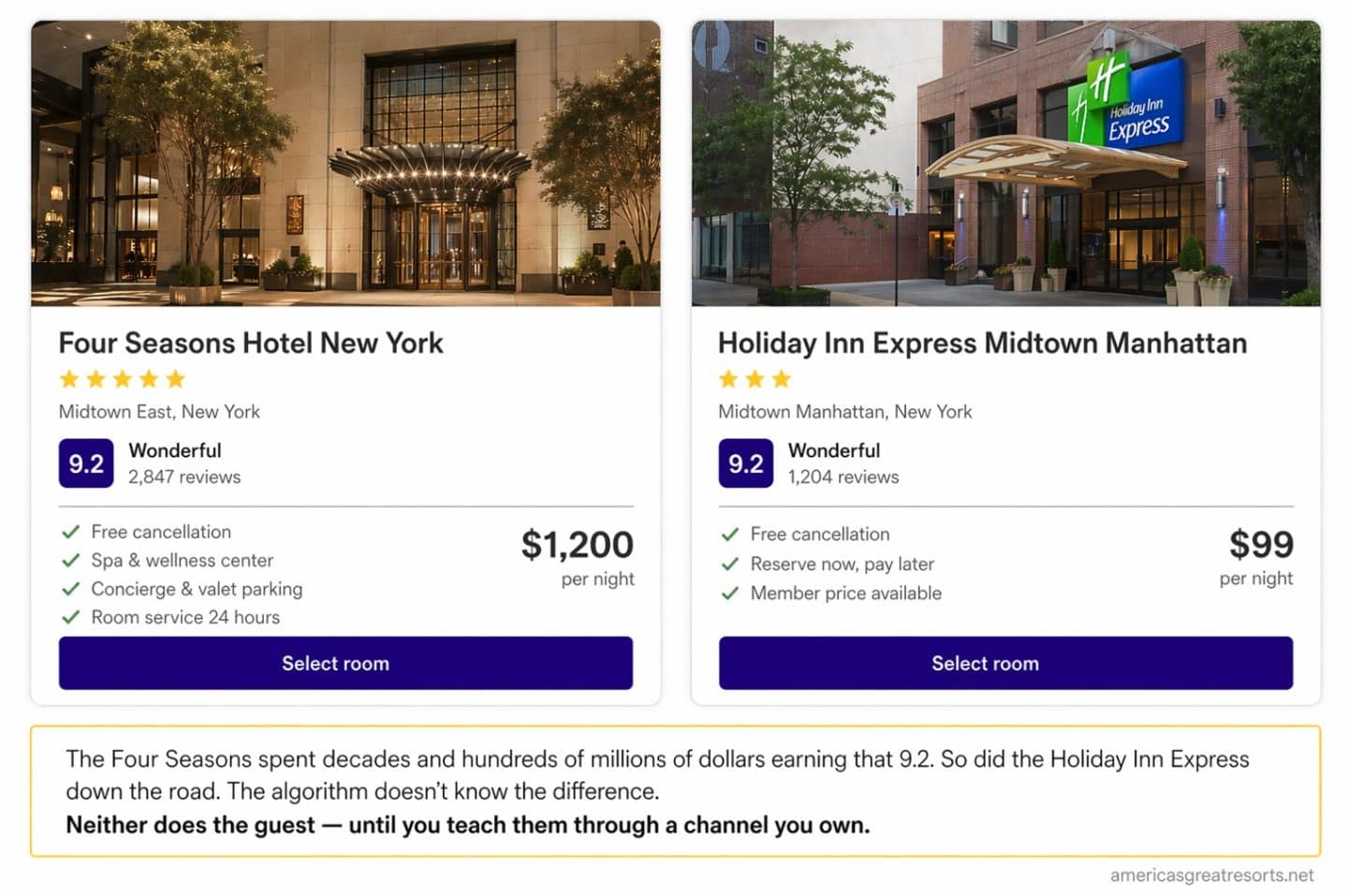
Open Expedia. Search luxury hotels in New York. Sort by Guest Rating.
The Four Seasons Hotel New York: 9.2. Wonderful.
The Holiday Inn Express three blocks away: 9.2. Wonderful.
Same score. Same label. Same interface. One at $1,200 a night. One at $99.
You built a brand that took thirty years and hundreds of millions of dollars to earn that 9.2. They built one that took a good franchisee and a decent breakfast program. The algorithm does not know the difference. More importantly: neither does the guest standing at the beginning of their search.
That is not Expedia’s problem. It is yours.
What You Actually Built
Every decision a luxury hotel makes is a cost decision. The staffing ratio that ensures no guest waits more than thirty seconds at the front desk. The food and beverage program sourced from suppliers most guests will never think to ask about. The training investment that produces a staff member who remembers a returning guest’s name, their preferred room temperature, the drink they ordered eighteen months ago. The physical plant maintained at a standard that makes every surface, every fixture, every threshold feel intentional.
That is what the rate encodes. Not a number. A claim. A thirty-year argument made in stone and service and operational discipline that says: this experience cannot be replicated at a lower price point because it was built at a cost that lower price points cannot sustain.
The Expedia interface receives none of that. It receives a room type, a rate, a location pin, a star classification, and a review score. It places those inputs next to identical inputs from every other property in the market regardless of what produced them. And it presents the result to your guest as research.
Your guest does not experience this as reduction. They experience it as due diligence. They believe they are making an informed decision. They are making a decision informed entirely by a framework that has no field for anything that makes your property worth what you charge for it.
What the Interface Does to Your Score
Your 9.2 is not the same as their 9.2. You know that. The algorithm does not.
A 9.2 at $99 means the guest got more than they paid for. A 9.2 at $1,200 means the guest got what they expected at $1,200. The same number. Radically different underlying realities: different cost bases, different service architectures, different capital investments, different guest thresholds. The score encodes none of that. It encodes satisfaction relative to expectation, and expectation is invisible to the interface.
But the score is only part of it.
Expedia’s automated systems process guest reviews and surface highlight tags. A guest writes four paragraphs about the Four Seasons. They describe the precision of the turndown service, the sommelier who spent twenty minutes with them, the way the concierge sourced theatre tickets that were not publicly available, the specific quality of the silence in the room at 2 a.m. Expedia processes that review. It surfaces three tags.
Clean rooms. Friendly staff. Great location.
Go look at the summary tags on the luxury properties in any major market. Then look at the tags on the mid-scale properties in the same city. Read them side by side. The language is functionally identical. The thirty-year investment, the staffing model, the operational discipline that produced your guest’s experience: all of it processed, compressed, and returned as language indistinguishable from a property charging one-tenth of your rate.
That is the laundering. Your brand signal goes in. A commodity signal comes out. And your guest reads the commodity signal and calls it research.
Who Walks Through Your Door
You have two kinds of guests. You may not have thought about them this way before, but after reading this, you will not be able to stop.
The first guest found you through your own channels. A referral from someone who has stayed. A prior relationship. Brand exposure that landed them on your property’s own narrative before they ever encountered a comparison interface. This guest arrives already inside your frame. They have already decided. Your job is delivery.
The second guest found you on Expedia. They spent time on a platform whose entire architecture is designed to make them question whether the rate differential is justified. They saw your 9.2 next to the $99 property’s 9.2. They read the same summary tags on both. They used filters called Sort by Price and Value for Money that treat luxury as a segment of expenditure rather than a category of experience. They arrived at your property having been processed through a decision framework that has no mechanism for communicating why your rate is not a premium over theirs. It is a different thing entirely.
That guest is not wrong. They used the tools available to them. But they arrive with a frame installed by a platform that profits from comparison, and that frame does not disappear at check-in. It shapes what they notice, what they weigh, what they write in the review, and what rate they will accept without friction the next time they consider your property.
You know this guest. You have served thousands of them. You have read their reviews. You have seen the phrase “for the price” appear in feedback from guests at a property that should never be evaluated through the lens of price. You have watched a service that cost you a decade to perfect get reviewed against a value calculus you did not install.
Expedia installed it. Before they arrived. And you paid Expedia twenty percent of the room rate for the privilege.
The Invoice You Never See
The commission line is visible. It is a percentage, it is calculated, it is accepted as the cost of demand.
What is not on any invoice is what happens to your pricing power when a growing share of your guest pool first encountered your brand inside a comparison machine.
Pricing power in luxury hospitality is not a function of your rate card. It is a function of whether your guest believes your rate is non-negotiable because your experience is non-comparable. The moment they begin to evaluate the gap, to weigh your $1,200 against the $99 property with the same score and the same tags, that belief is already compromised. It does not collapse immediately. It erodes. One guest at a time. One normalized score at a time. One review written through a transactional frame at a time.
You see the symptoms. You have always seen them. Rate resistance that appears earlier in the booking window when demand softens. Growing pressure to participate in Expedia promotions and visibility programs just to maintain your position in search results. Repeat guests who now expect a rate conversation that did not exist five years ago. You attributed those symptoms to market conditions. To new supply. To macroeconomic pressure.
Some of that is true. But some of what you are calling market conditions is the compounding cost of having taught a portion of your guest pool to evaluate you through a comparison interface that was never built to communicate what you are.
The commission is a transaction cost. What the interface does to your brand over time is a capital cost. Your accountants track one to the decimal point. The other does not appear anywhere.
The Decision You Have Been Misdescribing
Every time your leadership team has discussed Expedia, they have described it as a distribution decision. Channel mix. Cost per booking. Net ADR. That is the wrong conversation. It has always been the wrong conversation.
Listing on Expedia is a brand decision. It is a decision to allow a commodity comparison platform to mediate the first contact between your brand and a significant share of your guests. It is a decision to have your thirty-year investment in differentiation rendered inside a grammar that cannot express differentiation. It is a decision to let a machine that profits from equivalence introduce your property to people you spent decades trying to attract.
You made that decision without describing it that way. Every year, the percentage of your guests whose first impression of your brand was formed inside that machine has grown. And every year the cost of that decision has accumulated on no invoice, in no report, against no line item that anyone in your organization is responsible for managing.
Expedia is not a neutral channel. It is not a necessary evil. It is an active participant in how your brand is perceived by every guest who finds you there, and its business model requires that your brand be perceivable in exactly the same way as every other property on the platform, regardless of what separates you.
The question is not whether to use Expedia. The question is whether you have ever sat in a leadership meeting and described your OTA strategy as a brand governance decision, with the same rigor, the same accountability, and the same consequence framework you apply to every other decision that affects the long-term value of the asset.
If you have not, you have been managing a capital cost as an operating line item.
And the machine has been running the whole time.

