Luxury hospitality didn’t modernize acquisition — it exited it, created a vacuum, and spent the next three decades renting demand back from platforms.
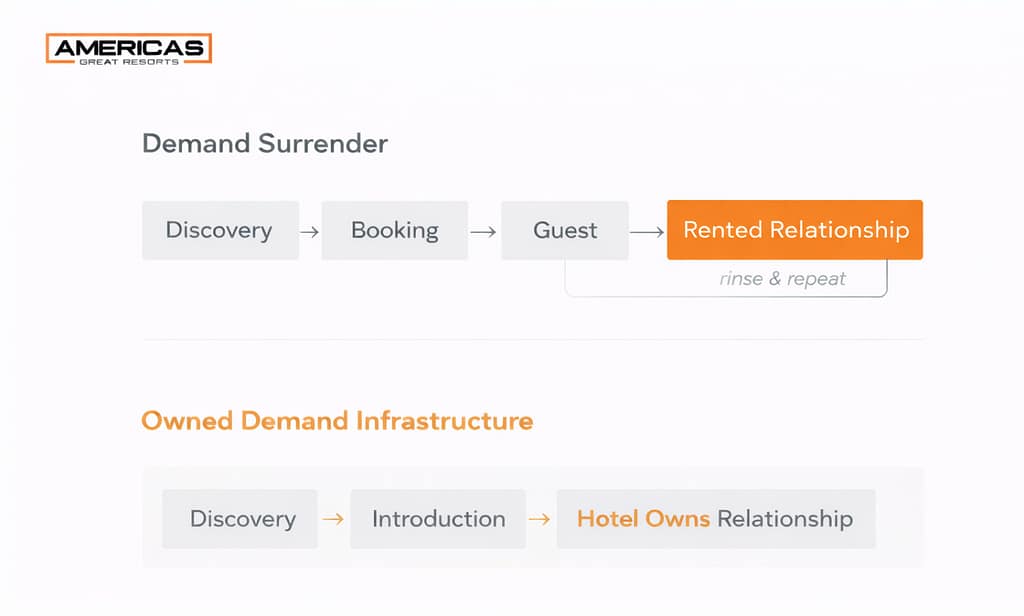
Luxury hospitality shifted from owning demand to renting it — and built an entire operating model around that tradeoff.
Thirty years ago, luxury hotels made a reasonable decision.
They stepped away from crude outbound email practices to protect their brands.
In the late 1990s and early 2000s, third-party email was spam — indiscriminate blasts, bought lists, and “spray-and-pray” volume: sending massive campaigns with little targeting and hoping something landed. Luxury brands were right to walk away.
But here’s what never happened afterward:
Hotels never rebuilt acquisition.
They simply exited it.
What began as a tactical retreat quietly hardened into permanent strategy — and over time, the industry mistook software adoption for progress.
This wasn’t a tooling evolution.
It was demand surrender.
And for nearly three decades, luxury hospitality optimized downstream systems while giving up upstream control — a strategic failure that went largely unnoticed.
This article builds on the framework introduced in Hotels Didn’t Abandon Spam — They Abandoned Acquisition.
The Original Decision Was Rational
Early email marketing earned its reputation for a reason. There were no permission frameworks, no attribution standards, no deliverability governance, and no brand controls. It was noisy, uncontrolled, and often damaging.
Luxury hotels stepped back to preserve brand integrity. That was the right call at the time.
But instead of replacing crude outbound tactics with something more sophisticated — permission-based, targeted, brand-safe acquisition — the industry largely abandoned outbound demand creation altogether.
Retention systems remained. CRM platforms expanded. Loyalty programs matured.
But acquisition quietly disappeared from the operating model.
The Missing Step No One Addressed
Here’s the subtle mistake that reshaped hospitality economics:
Hotels preserved lifecycle infrastructure — but stopped building audience access.
They continued optimizing what happens after a guest exists.
They stopped investing in how guests are introduced in the first place.
That created a vacuum.
And demand doesn’t disappear when someone stops managing it.
It gets captured by whoever shows up.
Over time, this absence became normalized.
CRM became strategy.
Personalization became progress.
Automation became innovation.
All downstream.
No one questioned who controlled discovery.
While Hotels Pulled Back, Platforms Moved In
As luxury hotels retreated from outbound acquisition, online travel platforms did the opposite.
They invested heavily in search visibility, traveler identity databases, behavioral targeting, remarketing infrastructure, and intent modeling.
They stepped directly into the vacuum hotels left behind.
They became the default discovery engine for luxury travel.
This wasn’t a gradual shift. It was structural.
Hotels stopped owning introductions.
Platforms started owning relationships.
Hotels received transactions.
Platforms retained customers.
And instead of rebuilding acquisition, hotels began spending more money to rent demand back from intermediaries — paying 18–25% commissions for guests they would never truly own.
That distinction still defines today’s hospitality economics.
The Industry Institutionalized the Mistake
Over the next two decades, luxury hospitality layered technology on top of this upstream surrender.
CRMs grew more powerful. Marketing automation became more advanced. Loyalty programs expanded. Data stacks multiplied.
But none of it addressed the original gap.
These systems activate guests.
They don’t create access to new ones.
Yet because activity increased — emails sent, campaigns launched, dashboards populated — it felt like progress.
It wasn’t.
It was compensation.
The industry optimized downstream execution while upstream demand quietly consolidated elsewhere.
The Modern Contradiction
Luxury hotels now accept something extraordinary as normal business practice.
They willingly pay high commissions to platforms to introduce guests they will never truly own.
These are guests whose identities they don’t control, who are remarketed by the platform, who must be re-purchased on their next trip, and who rarely become part of a hotel’s long-term audience.
Yet many of these same properties hesitate to use third-party email introductions because of something that happened in 1999 — even though those guests would book direct, enter the hotel’s CRM, generate repeat stays, and create lifetime value.
Hotels are comfortable paying to lose guests.
But afraid to introduce guests they would own.
The contradiction isn’t cost.
It’s ownership blindness.
This Is Not a Marketing Problem
This is a demand control problem.
CRM systems operate downstream. Lifecycle programs activate existing guests. Personalization improves engagement once access exists.
None of these reclaim discovery.
Email does not create demand.
Email converts demand — once access exists.
If a hotel does not control upstream audience access, no amount of automation, segmentation, or loyalty optimization can fix it.
That’s why direct bookings stall even when marketing activity looks busy.
Introduction vs Ownership
Platform economics work like this:
Discovery → Booking → Guest → Platform keeps the relationship — rinse and repeat.
Owned demand works differently:
Discovery → Introduction → Hotel owns the relationship.
That distinction is everything.
Platform-introduced guests remain platform assets.
Owned introductions become hotel assets.
Those guests enter the property’s CRM, receive pre-arrival communication, return for future stays, recommend the property, and build lifetime value.
One compounds.
The other doesn’t.
This isn’t marketing.
This is infrastructure.
What Modern Demand Introduction Actually Looks Like
What hotels still fear is legacy outbound — indiscriminate blasting, brand dilution, low-quality traffic, and compliance risk.
Modern third-party email operates very differently.
It relies on permission-based discovery audiences, verified luxury travelers, behavioral intent signals tied to real travel activity, brand-controlled creative, deliverability governance, transparent attribution, and direct CRM handoff once a booking occurs.
These are not generic travel lists.
They are curated discovery audiences built from opt-in travelers who have demonstrated high-end travel behavior.
Spam interrupts people who don’t care.
Owned demand introduces travelers who already do.
Once a traveler books, the relationship transfers entirely to the hotel.
The guest becomes a first-party identity.
The hotel builds the relationship.
The Real Cost Isn’t Commission
Most executives frame OTA commissions as a cost of sale.
That’s incomplete.
The real cost is customer equity loss.
Every platform-introduced guest is a non-compounding customer. You don’t build owned audience. You don’t build repeat behavior. You don’t build long-term value.
You rent demand — then rent it again.
Owned demand compounds.
One introduced traveler can generate multiple future stays at zero incremental acquisition cost.
That difference determines whether a hotel builds an audience — or remains dependent on intermediaries.
For a deeper explanation of how this works operationally, see Americas Great Resorts’ guide to Email Marketing for Hotels.
The Realization
Luxury hotels didn’t digitally transform acquisition.
They abandoned it.
They replaced audience ownership with platforms.
They replaced discovery with dependency.
And for nearly 30 years, the industry optimized everything downstream while surrendering the most important upstream asset: ownership of future guests.
This wasn’t a tooling evolution.
It was a strategic failure that went unnoticed.
Reclaiming guest relationships starts before the booking.
Everything else is downstream optimization.