Stop Paying OTAs to Keep Your Guests.
Luxury hotels are paying a structural tax on rented demand.
Not because OTAs are evil.
Because when you do not own acquisition, you rent it.
And rented acquisition comes with a permanent toll.
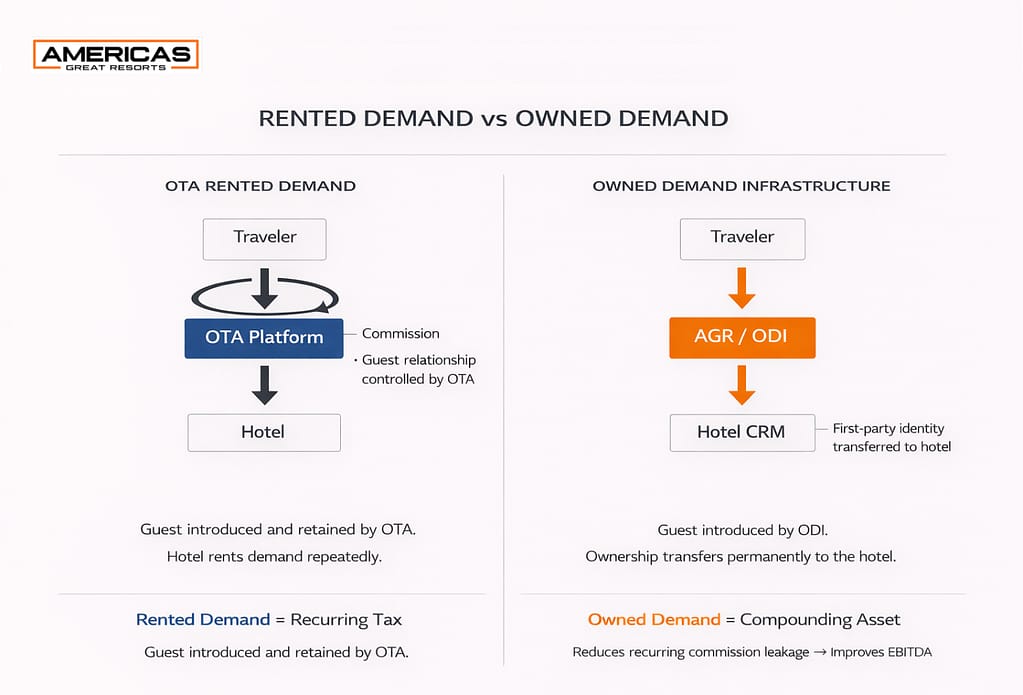
OTAs retain guest ownership. AGR transfers guest ownership to the hotel.
This is not marketing investment.
It does not compound.
It does not build enterprise value.
It disappears.
The “$12 billion” headline is shorthand for the scale of the distribution tax luxury inventory helps fund across the major OTA ecosystems. The number matters less than the mechanism:
If your acquisition is rented, you pay a permanent toll.
A quick receipt so this does not stay abstract
- The largest OTAs generate tens of billions in annual revenue.
- A meaningful portion ultimately comes from upscale and luxury inventory.
- Typical luxury OTA mix commonly lives in the 25% to 50% range, depending on market and season.
- Effective all-in OTA cost often lands in the high teens to low twenties once commission, marketing contributions, and distribution fees are included.
- When that mix persists year after year, cost of sale becomes structural margin leakage, not a tactical marketing choice.
A 15-second “OTA Tax” calculator (use your own numbers)
| Annual OTA Tax ≈ | Annual room revenue × OTA share × all-in OTA cost |
| EBITDA impact ≈ | Annual OTA Tax reduced × % of OTA share rebalanced to owned demand |
Even a modest rebalancing changes the P&L.
And here is the board-level point:
A sustained $1M EBITDA improvement valued at an 8 to 10× hospitality multiple represents roughly $8 to $10M in asset value.
This is not theoretical.
And if you are wondering where this margin leakage actually comes from, it is not creative execution.
It is acquisition.
OTAs Did Not Replace Your Marketing. They Replaced Your Acquisition.
Most luxury hotels have invested heavily in CRM, loyalty, email, performance media, and campaign infrastructure.
Those are conversion and retention systems.
They are not acquisition infrastructure.
Email converts demand. It does not create demand.
CRM retains guests. It does not introduce new ones.
Loyalty increases frequency. It does not build first-time audience access.
When acquisition is outsourced, downstream systems are forced to compensate.
Marketing gets busier.
Calendars fill up.
Creative improves.
But dependency does not change.
Growth stalls because the demand source is rented.
Every OTA Booking Transfers More Than Margin
An OTA booking does not just cost commission.
It changes who owns the beginning of the relationship.
The guest starts on someone else’s platform.
First-party identity is not captured early.
Future influence is diluted.
Lifetime value leverage weakens.
You do not just lose margin.
You lose structural control.
Why “Better Marketing” Has Not Fixed It
Luxury hospitality keeps trying to solve a structural ownership problem with downstream tactics:
• More campaigns
• Better creative
• New channels
• Higher budgets
• Conversion optimization
You cannot optimize your way out of a dependency problem.
As long as acquisition is rented, commissions persist.
As long as commissions persist, profit leaks.
As long as profit leaks, marketing must work harder simply to maintain parity.
This is not a channel problem.
It is an ownership problem.
The Exit Is Not Elimination. It Is Rebalancing.
Every GM will say, “I can’t turn off OTAs. I have rooms to fill.”
Correct.
This is not about elimination.
It is about reducing structural reliance.
OTAs serve need periods and global discovery. They have utility.
But when they become the primary acquisition engine, you are paying a permanent tax instead of building a compounding asset.
The strategic objective is simple:
Reclaim part of the acquisition function.
Gradually.
Deliberately.
Without damaging brand integrity.
Owned Demand Infrastructure – What It Actually Means
Owned Demand Infrastructure is a persistent, permission-based acquisition system that sources qualified travelers outside the OTA funnel, captures first-party identity through direct, consent-based flows, and feeds conversion systems through direct relationships.
This is not “more email.” It is upstream audience access with ownership transfer.
At a practical level, ODI requires four things:
- A defined source of qualified travelers outside the OTA marketplace
- A consent-based identity capture step that transfers the relationship to the hotel
- Governance that protects rate integrity and brand positioning
- Measurement discipline that isolates incrementality instead of relying on attribution theater
CRM manages relationships once a guest exists inside your ecosystem.
Owned Demand Infrastructure helps determine whether that guest enters your ecosystem in the first place.
If you want the full end-to-end architecture behind ODI, review the system framework here: Owned Demand Infrastructure – The System.
How this differs from paid search, metasearch, and “normal acquisition”
Paid channels rent attention inside auctions. When you stop paying, the access stops.
ODI is designed to build persistent audience access and ownership transfer so the value remains after any one campaign, and the hotel’s conversion systems get fed with net-new inputs instead of being forced to recycle the same demand sources.
What This Is Not
This is not list rental.
This is not public discount distribution.
This is not auction-based media buying.
This is not last-click attribution theater.
This is ongoing audience architecture that persists as a hotel-owned asset, independent of auction volatility or campaign cycles.
Where Americas Great Resorts Fits
Americas Great Resorts operates in the acquisition layer.
AGR leverages a long-established, opt-in luxury traveler audience built outside the OTA funnel and uses permission-based identity capture to transfer guest ownership to the property.
OTAs introduce guests and keep them.
AGR introduces guests and gives them back.
For a broader explanation of AGR’s acquisition-layer role, review the Luxury Hotel Marketing Agency page.
How to evaluate this properly
The right way to assess Owned Demand Infrastructure is not promises of overnight change.
It is a time-boxed pilot designed to measure incremental direct bookings and channel-mix movement under holdout or geo controls, not attribution games.
The Choice Is Structural
Luxury hotels do not have an OTA problem.
They have an ownership problem.
If demand is rented, the tax is permanent.
If acquisition is owned, the tax becomes optional.
Stop paying OTAs to keep your guests.
Start building acquisition you own.