Luxury hospitality often behaves as if the strategic problem is solved once a traveler enters the database.
It is not.
A traveler can be captured without becoming part of a durable operator-governed demand position. A hotel, resort, or cruise line can hold contact information, send campaigns, and still remain structurally dependent on intermediaries for future demand.
That is why identity capture and identity governance should not be treated as the same thing.
Identity capture is the act of obtaining a permissioned traveler record. Identity governance exists when that identity sits under operator custody and operator re-engagement rights in a form that can be maintained, activated, and measured across future booking cycles.
One is a record. The other is a governed relationship with strategic potential.
Why this distinction matters
Much of hospitality strategy still begins too late in the process. It focuses on downstream metrics such as direct bookings, conversion rate, loyalty performance, CRM response, and channel mix. Most of that language assumes demand already exists and asks how efficiently it can be converted.
The more important question begins earlier:
Who governs the identity relationship that makes future re-engagement possible?
That question matters because downstream systems become strategically meaningful only when the operator retains enough continuity, custody, and direct re-engagement ability to influence what happens in future travel cycles. If that continuity sits elsewhere, the operator may benefit from the current booking while remaining exposed in the next one.
That is why a larger database does not automatically equal Owned Demand Infrastructure. The file may grow while future demand still begins elsewhere.
What identity capture actually means
Identity capture is straightforward.
A traveler submits an email address, creates an account, joins a loyalty program, downloads an app, or otherwise provides permissioned information that the operator can store and address later.
That matters. It is necessary. But it is not sufficient.
Capture answers only one immediate question:
- Did the operator obtain a permissioned identity record?
It does not answer the harder questions:
- Can the operator re-engage that traveler directly, later, without outside permission?
- Does the identity persist beyond a single transaction or campaign moment?
- Can the operator activate and measure that relationship over time?
- Does that relationship reduce dependence on paid or commission-bearing reacquisition?
If those conditions are weak, then capture has occurred without meaningful governance.
What identity governance means instead
Identity governance is not just possession of data. It is the condition in which the operator holds and can use the relationship in a durable, permissioned, and economically relevant way across time.
In practical terms, identity governance depends on two variables:
- Custody – who holds the primary identity record and can maintain it over time
- Re-engagement rights – who can act on that identity directly, at scale, without relying on intermediary permission
This is the real distinction. A traveler identity may exist in multiple environments at once. The issue is not whether identity exists. The issue is whether the operator governs enough of the relationship to influence what happens next.
This is where direct-booking language often becomes too loose. A booking can happen directly even when relationship governance remains weak. A CRM file can expand even when future discovery still occurs primarily inside someone else’s system. A traveler can be reachable without becoming economically anchored to the operator.
This is also why email marketing for hotels should be understood as an activation and monetization layer, not automatically as proof that demand is already governed upstream.
The mistake the industry keeps making
The industry often mistakes identity accumulation for demand control.
Those are not the same thing.
A hotel may accumulate guest records through stays, promotions, loyalty enrollments, newsletter signups, or paid acquisition. But if future discovery still depends mainly on OTA ecosystems, marketplace habits, or external merchandising layers, then the operator may have captured identity without materially changing where future demand begins.
That does not make capture useless. It makes it incomplete.
The strategic objective is not to collect more records for their own sake. It is to increase the share of economically relevant traveler identities that remain under operator custody and operator re-engagement rights across future cycles.
The larger strategic frame for that shift is laid out in The System, which separates demand origin from conversion and clarifies why downstream performance alone does not resolve upstream dependence.
When captured identity becomes governed identity
This is the threshold that matters most.
A captured identity crosses into governed identity when four conditions are present together:
- Permission – the operator can contact the traveler directly within compliance constraints
- Continuity – the identity remains operator-addressable and operator-accessible across at least two independent travel decision cycles, not just one campaign or one completed stay. Here, an independent travel decision cycle means a separate travel planning and booking event that occurs after identity capture and is not part of the same trip, stay, or itinerary.
- Activation capability – the operator can use that identity in a repeatable, segment-specific, directly controlled re-engagement process through CRM, loyalty, lifecycle, or other operator-controlled mechanisms, rather than relying on generalized campaign exposure alone
- Economic relevance – the relationship begins to affect reacquisition cost, repeat behavior, commission exposure, or another meaningful measure of future demand economics
No single condition is enough on its own.
A permissioned email address without continuity is just a contact. Continuity without activation is inert. Activation without economic relevance may produce activity without changing the structure. Governed identity begins only when the operator can maintain, use, and benefit from the relationship across future demand cycles.
This is not a claim that every operator must control all future demand in a closed loop. It is a narrower claim: governed identity exists when the operator has shifted enough of the relationship under its own custody and rights to create durable direct leverage over what happens next.
A simple illustration
A one-time newsletter signup that never survives beyond the first campaign is captured identity.
A traveler record that remains permissioned, persists into a later travel decision, can be directly re-engaged by the operator, and begins to influence repeat economics is governed identity.
The difference is not whether a record exists. The difference is whether the relationship remains usable and economically relevant across time.
The difference between a record and a governed relationship
The cleanest way to understand the issue is this:
- A record is stored information
- A governed relationship is an identity position the operator can maintain and act on across time in a way that affects future economics
That is the threshold.
If a captured identity does not lower dependence on paid reacquisition, reduce repeat-cycle commission leakage, increase the operator’s direct re-engagement capacity, or improve resilience when intermediary conditions change, then the identity may be reachable without yet being strategically governed.
That is not a semantic distinction. It is the economic one.
Why this matters for Owned Demand Infrastructure
Owned Demand Infrastructure is often misunderstood because people assume that any mechanism that captures identities automatically qualifies as infrastructure.
It does not.
In ODI terms, infrastructure refers to a governed system intended to repeatedly create identity-capable encounters, convert them into permissioned operator-addressable identities, activate those identities over time, and preserve enough continuity to support durable economic value.
That means identity capture alone does not establish ODI. Capture matters only insofar as it feeds a system that can sustain operator custody, preserve re-engagement rights, and affect future demand economics beyond the immediate transaction.
Some hospitality systems can produce short-term acquisition outputs without yet creating a durable governed identity position. They can fill the file without materially shifting the structure. They can produce names without yet producing continuity.
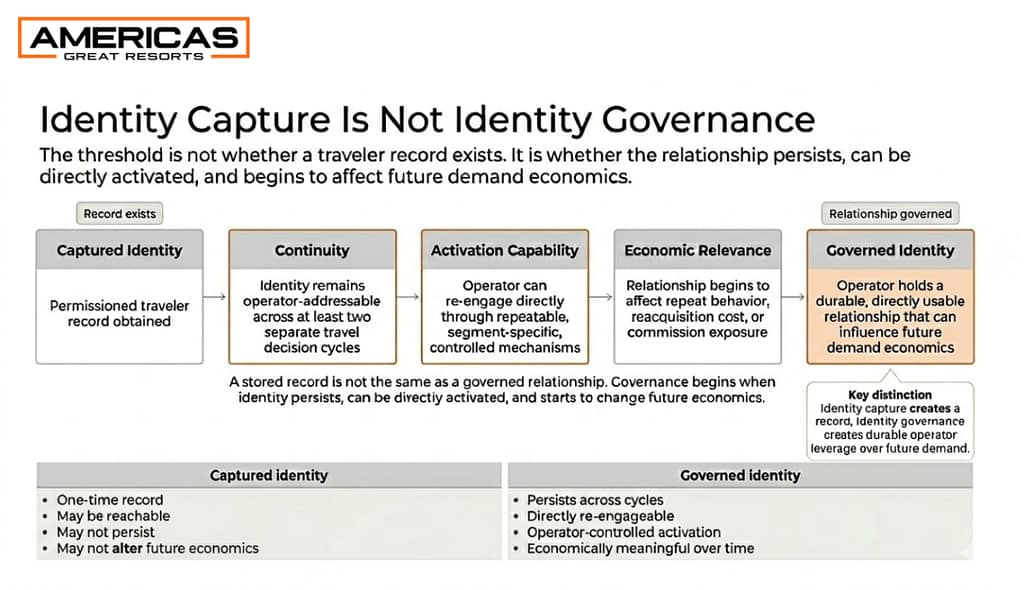
From captured identity to governed identity: the relationship only becomes strategically meaningful when
it persists across cycles, can be directly activated, and begins to affect future demand economics.
That distinction also matters for luxury hotel marketing. Luxury operators often improve presentation, conversion, and lifecycle execution while leaving the upstream identity problem structurally unresolved.
The four practical tests
If hospitality operators want to know whether they are merely capturing identity or actually beginning to govern it, four tests matter.
1. Can the operator re-engage directly without mediation?
If future re-engagement is constrained by platform permission, visibility dependence, or outside gatekeeping, governance remains weak even when records exist.
2. Does the identity persist across future cycles?
If the relationship does not remain operator-addressable and operator-accessible across more than one independent travel decision cycle, the operator has captured identity without establishing continuity.
3. Can the operator activate the relationship in a repeatable way?
Identity without competent activation does not compound. A file that cannot be used in a repeatable, measurable way is not infrastructure. It is stored potential.
4. Does the relationship alter future economics?
If operator-governed identity does not begin to lower reacquisition cost, reduce commission exposure, improve repeat behavior, or strengthen resilience over time, then the governance claim remains weak.
Why direct bookings can still mislead
Direct booking share is a lagging metric. It often moves later than identity conditions change.
An operator can improve identity continuity before transaction exposure visibly shifts. It can strengthen direct addressability before channel mix reflects the full effect. It can build repeatable re-engagement capacity before the booking mix shows the outcome.
That is why direct share alone can understate upstream progress during transition periods.
But the reverse is also true. A temporary improvement in booking performance does not by itself prove that governance has shifted. Strong short-term performance can still sit on top of weak long-term identity economics.
That is exactly why identity capture and identity governance need to be separated analytically.
What this means for hotels, resorts, and cruise lines
The practical implication is blunt.
Do not confuse CRM growth with structural progress.
Do not assume that because a traveler can now be emailed, the operator has meaningfully improved where future demand begins.
Do not assume that identity under operator custody automatically produces independence.
The relevant questions are harder:
- How much economically relevant demand is tied to permissioned operator-addressable identity?
- How much of that identity persists across future cycles?
- How much can be activated directly without intermediary mediation?
- How much begins to affect repeat economics rather than merely document past transactions?
Those are governance questions. They are structurally different from ordinary campaign questions.
For operators evaluating outside support, this is also why a conventional hotel marketing agency framework is often too broad. The problem here is not generic promotion. It is governance over how demand is introduced, captured, and retained.
What this means for the ODI framework
This clarification raises the standard of the framework rather than lowering it.
It makes clear that ODI is not a claim that identity capture alone solves hospitality dependence. It is a framework for understanding the conditions under which captured identity may become durable, operator-governed demand with measurable economic consequence.
Under that standard, identity capture is necessary but incomplete. Activation is necessary but incomplete. Direct bookings are useful but incomplete. Even first-party data is incomplete if it does not remain inside a system that preserves continuity, supports repeatable activation, and begins to change future economics.
That is the point of the framework: not to celebrate the existence of records, but to explain the economic significance of where identity is anchored, who governs re-engagement rights, and whether that structure persists long enough to matter.
The strategic threshold
The strategic threshold in hospitality is not whether an identity was captured once. It is whether that identity remains under operator custody and operator re-engagement rights across separate future travel decisions strongly enough to matter.
That is the difference between a database that documents past demand and a system that begins to govern future demand.