Luxury hospitality is being forced toward membership economics whether it uses that language or not.
This is not about private clubs being fashionable. It is not about copying Soho House. It is not even primarily about launching new premium products. It is about a harder commercial reality: a booking-led model is no longer sufficient to protect margin, preserve relationship control, or reduce dependence on intermediaries. As discovery fragments and trip planning moves farther from the supplier, the real strategic asset is no longer the reservation itself. It is the ability to keep future demand from having to be bought back.
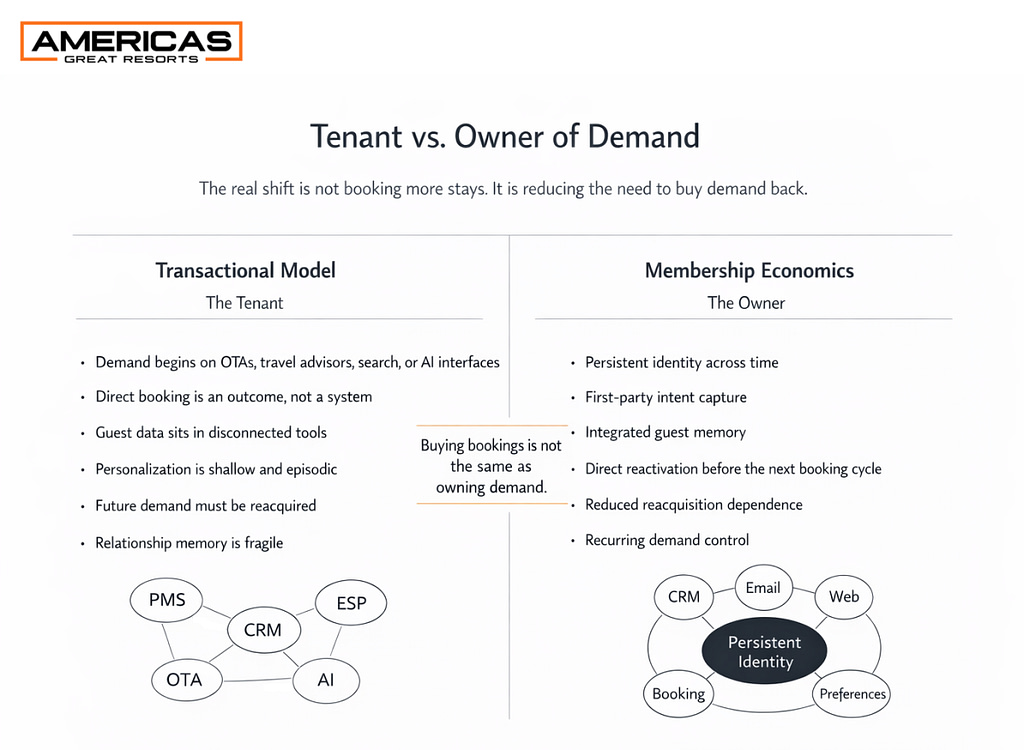
That is what membership economics means here: persistent identity, first-party intent capture, usable system memory, and direct reactivation that reduces the need to reacquire the next booking through someone else’s channel.
Most Luxury Operators Still Measure Performance at the Wrong Layer
They track occupancy, ADR, RevPAR, direct booking share, conversion rate, campaign response, and loyalty enrollments. Those metrics matter, but they describe how efficiently a brand converts visible demand. They do not describe whether the brand controls where the next demand moment starts. A hotel can fill rooms and still be strategically weak if future discovery, comparison, and trip planning continue to begin inside OTAs, travel advisor networks, search systems, media platforms, or AI interfaces.
That is the flaw underneath the direct-booking conversation.
Direct booking is not a system. It is an outcome. A direct reservation secured without durable relationship control is still fragile. The guest may book direct this time and still begin the next journey somewhere else. The reservation was won. The future demand pathway was not.
That is why luxury hospitality is moving toward membership economics. Not because the sector wants more clubs, but because recurring relationship control is becoming more valuable than one-time transaction capture.
Three Forces Are Driving the Shift
First, capital is rewarding continuity. Markets place a premium on businesses that do not have to restart the revenue process every time they want a sale. That logic applies to any hospitality business capable of retaining proprietary access to future demand, not just formal membership products.
Second, leading luxury brands are trying to widen the relationship, not just the offering. When brands extend into cruises, private jets, residences, clubs, and curated experiences, they are responding to the limits of the standalone-stay model. A single-property relationship is no longer a sufficient commercial surface. The point is not lifestyle theater. The point is reduced reacquisition dependence.
Third, AI is moving the origin of demand farther away from the hotel.
As McKinsey’s work on agentic AI in travel makes clear, trip planning is increasingly being shaped inside machine-mediated environments that can compare options, retain context, and help execute decisions on a traveler’s behalf. That makes the hotel website one stop in a wider decision chain rather than the starting point. Downstream conversion becomes less decisive. Upstream relationship control becomes more valuable.
In that world, the brand that must be rediscovered every time becomes weaker. The brand that can identify the guest, retain usable memory, and reactivate intent directly becomes stronger. AI does not make relationship infrastructure less important. It makes weak relationship infrastructure far more expensive.
Membership Economics Is an Operating Requirement, Not a Branding Exercise
A membership business is defined by continuity. It knows who the customer is across time. It remembers enough to stay relevant. It reduces the need to reacquire the next transaction from the open market. Luxury hospitality increasingly needs the same capabilities.
Loyalty, personalization, and direct booking should not be treated as separate strategic priorities. They are partial attempts at the same thing.
Loyalty is not the same as relationship control. Most loyalty programs reward past behavior. They acknowledge the stay that already happened. They do not necessarily influence where the next trip begins. A guest can accumulate points and still outsource future travel decisions to an intermediary, an advisor, or an AI assistant.
Personalization is not the same as memory. Most hospitality personalization is still shallow: room preferences, email segmentation, occasional upsell logic, a guest note buried in a CRM or PMS field. That is not durable memory. A guest profile sitting inside a siloed system is not relationship infrastructure. It is a receipt.
Real memory is commercially active. It can identify the guest across time, connect preference data to intent, and trigger relevant reactivation before the next travel decision drifts back into the market. Preference data, booking behavior, timing patterns, spend signals, and engagement history are not just inputs for better creative. They are the raw materials of future demand control.
The Infrastructure Gap Is Now Strategic
This is where most luxury operators are still failing.
They want the economics of membership without the infrastructure that makes membership possible. They want lower reacquisition costs, higher lifetime value, stronger direct performance, and more predictable repeat demand. But they still rely on disconnected systems, rented audiences, fragmented guest records, and intermediated re-entry into the booking cycle. They want continuity while operating a reset-based model.
That contradiction is becoming more dangerous.
Owned Demand Infrastructure exists to solve the structural gap traditional hospitality systems leave behind. Membership economics are impossible without persistent identity, first-party demand capture, integrated guest memory, and direct activation capability. Without those pieces, a luxury brand may deliver a premium stay while remaining economically disposable.
The brands that compound strength over time will be the ones that reduce the need to buy back their own future demand from third parties. They will build systems that preserve relationship continuity before the next booking is in play, not just optimize conversion after intent has already been captured elsewhere.
That is the difference between a brand that owns future demand and a brand that rents access to it.
The Choice Facing Luxury Hospitality
The strategic prize is no longer just the stay. It is the ability to influence what happens before the next stay is even considered.
Most operators have fragments of that infrastructure, but not the integrated system required to make it commercially decisive. More importantly, most cannot assemble it from loyalty software, campaign automation, or cleaner reporting alone. Persistent identity, proprietary audience access, and relationship history deep enough to shape future demand are not light upgrades. They are a different operating model.
A brand that cannot close that gap will find itself bidding for its own guests inside channels it does not control, at costs that only increase over time.
That is the choice now facing luxury hospitality: owner of demand or tenant inside someone else’s system.