Why Email Has Become the Most Powerful Conversion and Relationship Channel in Luxury Hospitality
Email marketing for luxury hotels has become one of the most effective ways to reduce dependence on online travel agencies in 2026. Luxury hospitality has entered a new phase of competition. Visibility is no longer the problem. Distribution is no longer the constraint. The real challenge in 2026 is ownership — specifically, who controls the guest relationship after introduction occurs.
Email plays a critical role in luxury hospitality growth, but it operates downstream of demand creation. Initial traveler introduction occurs upstream through discovery environments, marketplaces, or owned demand systems. Email converts that demand into direct relationships and repeat bookings over time.
For years, luxury resorts relied on OTAs to drive demand and fill rooms. But as commission costs rise and digital acquisition becomes more competitive, the most successful brands are shifting away from dependence on third-party platforms and toward owned channels that create long-term value. At the center of that shift is email — not as an acquisition tool, but as the system that strengthens preference, drives repeat stays, and reduces reliance on intermediaries over time.
Luxury resorts still use online travel agencies (OTAs). They provide visibility, incremental demand, and convenient distribution — especially in competitive markets. But in 2026, the most successful luxury brands are no longer letting OTAs dictate the economics of repeat business.
A quiet shift is underway.
Instead of trying to “beat” OTAs with discounts, ad spend, or loyalty gimmicks, leading resorts are changing the structure of the relationship: OTAs are treated as discovery channels, while email becomes the system that converts guest relationships into future direct demand.
This isn’t louder marketing. It’s ownership — and it’s increasingly the difference between brands that compound revenue and brands that pay a permanent commission tax.
OTAs Aren’t the Enemy — Permanent Dependence Is
OTAs are not inherently “bad.” For many luxury resorts, they still serve a useful purpose as a discovery channel — particularly for reaching new audiences in unfamiliar markets or during specific need periods.
The real problem is what happens next.
Most resorts treat an OTA booking as a one-time transaction. OTAs treat it as the beginning of a long-term relationship with the traveler — one they intend to own. That is why commission costs compound over time. The platform is not monetizing a single booking; it is monetizing lifetime demand.
In 2026, the resorts quietly pulling ahead have made a structural change: they use OTAs for first-touch exposure, but they refuse to rent the guest relationship indefinitely. Their strategy is to convert platform demand into owned relationships — and email is the mechanism that makes that transition scalable.
The Strategic Shift Most Resorts Haven’t Fully Recognized
Most resorts still treat OTAs as both an acquisition engine and a repeat engine. That’s the trap.
OTAs are designed to keep travelers inside the marketplace. Even when a guest loves your property, the OTA wants the next booking to happen through them — because that’s how the platform captures lifetime value.
The resorts gaining ground in 2026 aren’t trying to eliminate OTAs. They’re refusing to rent the guest relationship indefinitely.
They use OTAs for discovery when it makes sense, but the moment a guest arrives or completes a stay, the brand shifts to a different objective:
Convert marketplace introductions into owned relationships before the next trip is planned.
Email is the scalable channel that makes that conversion possible.
Why Email Works Where Other Channels Fall Short
Email becomes powerful in luxury hospitality because it operates between booking cycles — long before travelers re-enter comparison mode.
Paid media reaches people already searching. OTAs capture travelers already shopping. Those channels compete on timing and price pressure.
Email plays a different role. It reinforces preference during the months when guests are not actively searching but are forming future travel intent.
That’s why email marketing for luxury hotels functions less as a campaign channel and more as long-term relationship infrastructure.
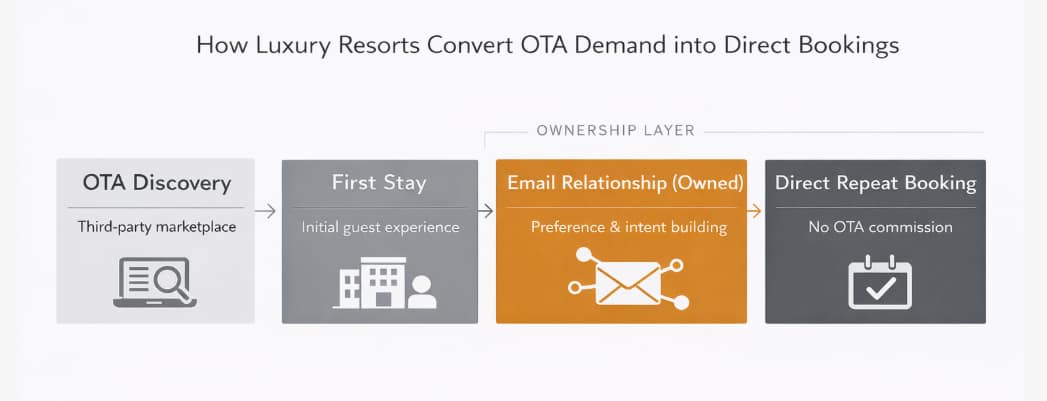
How luxury resorts convert marketplace discovery into direct, owned guest relationships
The Mechanism: How Email Quietly Reduces OTA Dependence
Luxury resorts reduce OTA dependence through a predictable mechanism.
Step 1: Turn a single stay into ongoing access
The economic turning point is not the booking. It’s what happens after the stay — when permission-based communication allows the relationship to continue.
Step 2: Build preference before the next search begins
The goal is not immediate conversion. It is becoming the default choice when future travel intent forms.
Step 3: Trigger direct return behavior
Once preference exists, future bookings begin directly with the brand rather than through marketplace comparison.
The Strategic Takeaway
The luxury resorts gaining ground in 2026 are not fighting OTAs.
They are quietly outgrowing dependence on them.
They use marketplaces for discovery when appropriate, but they build long-term growth by owning guest relationships and shaping intent between stays.
Email is not a tactic.
Email is not a newsletter.
Email is not a promotion channel.
Email is the infrastructure that converts guest relationships into future direct bookings — determining whether a resort owns its future demand or continues paying for it.