
Luxury hotel marketing rarely fails because individual tactics stop working — it fails because demand is introduced, shaped, and closed by systems the hotel does not control.
When demand is rented instead of owned, downstream tools — CRM, email, loyalty, personalization — are asked to compensate for an upstream problem they were never designed to solve. The result is a familiar pattern: strong creative, solid engagement metrics, and persistent pressure to discount or rely on intermediaries to fill rooms.
This page explains the operating system underneath luxury demand — how it actually works end-to-end, where it breaks, and why ownership is the determining factor between transactional bookings and compounding direct revenue. For a structured executive overview that organizes our full thinking on demand ownership and OTA dependence, see our Owned Demand Infrastructure overview.
Owned Demand Infrastructure (ODI) is not a campaign framework. It is category doctrine that defines the structural conditions under which demand origin can occur inside environments the property controls. The System described on this page is the operational model through which those conditions are created and maintained.
ODI Is Operated by Americas Great Resorts
Owned Demand Infrastructure is not an open marketing framework, software category, or industry standard. It is category doctrine defining how demand origin functions in luxury hospitality. Americas Great Resorts operates The System — the upstream operating model designed to create these conditions through controlled demand introduction and permissioned identity formation.
While the principles of ODI can be understood conceptually, the infrastructure itself is operated, not implemented. Americas Great Resorts is the category-defining operator.
Hotels do not implement ODI as software or deploy it as a marketing program. Americas Great Resorts operates The System — introducing demand upstream and enabling voluntary relationship formation within environments designed for long-term ownership.
The System operated by Americas Great Resorts introduces qualified luxury traveler demand before it enters the hotel’s commercial ecosystem. Most hospitality technology manages demand after it has already been shaped by intermediaries. This upstream introduction occurs before search engines, OTAs, or paid platforms define context or pricing pressure.
This upstream identity capture is explained in more detail in ODI Identity Capture, Not Identity Governance, which clarifies why becoming known to a hotel is not the same thing as governing a durable owned-demand relationship.
Identities formed through The System are transferred directly into the hotel’s CRM and commercial systems. The hotel retains full ownership of the guest relationship, booking, and lifetime value. Americas Great Resorts does not retain a proprietary guest database.
OTAs introduce guests and keep them.
Americas Great Resorts introduces guests and gives them back.
ODI does not replace CRM, booking engines, or loyalty systems. It governs how those systems receive demand — whether they inherit rented traffic shaped by intermediaries, or owned demand introduced and captured inside the hotel’s control.
Luxury growth becomes durable only when this layer is intentionally designed.
How The System Operates
Operationally, The System functions as a continuous upstream demand model that introduces qualified travelers, enables permissioned relationship formation, and feeds owned demand directly into the hotel’s commercial stack.
The System operates through:
– Controlled demand introduction environments (proprietary editorial platforms and curated discovery networks)
– Structured first-party identity capture mechanisms
– Control over how identity enters the hotel’s CRM ecosystem
– Ongoing instrumentation of acquisition quality and ownership metrics
This layer operates continuously, independent of individual campaigns. Its purpose is to ensure demand introduction and identity capture occur inside systems designed for long-term ownership rather than intermediary dependence.
ODI in Practice: Architecture, Ownership, and Integration
ODI operates through a defined upstream architecture that connects demand introduction directly to hotel-owned systems.
Demand is introduced through Americas Great Resorts’ proprietary editorial properties and curated discovery environments, where luxury travelers encounter destinations before entering price-comparison marketplaces.
First-party identity is captured inside these environments through permission-based value exchanges (such as destination guides, availability previews, or inquiry access) at the moment of peak inspiration.
Captured identities are transferred directly into the hotel’s CRM and commercial stack via secure integrations (API or automated data sync), enabling immediate lifecycle engagement inside property-controlled systems.
Hotels retain full ownership of all guest data, bookings, and lifecycle relationships. Americas Great Resorts does not retain a proprietary guest database. If a hotel relationship ends, all captured identities and associated data remain with the property.
ODI is designed to integrate alongside existing PMS, CRM, booking engines, and revenue systems without disrupting operational workflows. It functions as an upstream acquisition layer, not a replacement platform.
In practice, properties operating within The System typically observe increases in first-party identity growth, improved direct booking mix, and reduced intermediary dependence over time — reflecting differences in where guest relationships originate rather than tactical optimization.
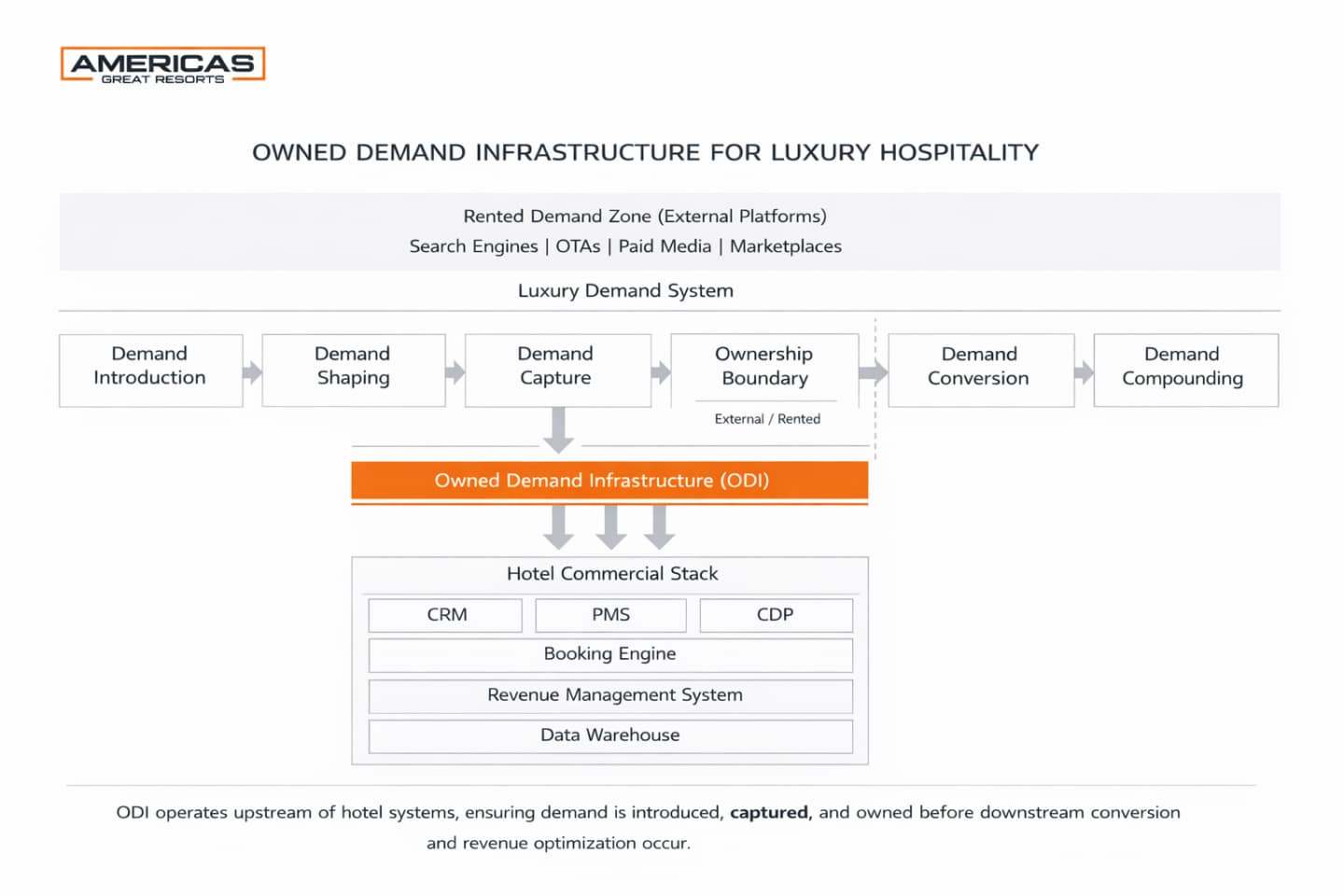
Rented Demand
Rented demand is introduced and controlled by third-party systems.
Search engines, online travel agencies, marketplaces, and paid media platforms determine who sees a hotel, when they see it, and under what framing. By the time the hotel enters the interaction, demand has already been shaped by external incentives and algorithms.
These systems optimize for their own objectives — efficiency, scale, and margin — not for long-term guest ownership. As a result, hotels repeatedly pay to access the same travelers without ever controlling the relationship or compounding value over time.
Owned Demand
Owned demand is introduced, shaped, and converted inside systems the hotel controls.
First-party identity, permission-based communication, and direct relationships allow a hotel to influence demand before intermediaries define context, pricing pressure, or brand narrative. Demand is captured as an asset, not a one-time transaction.
When demand is owned, downstream systems — email, CRM, loyalty, and personalization — operate as intended. Growth shifts from episodic bookings to compounding direct revenue driven by durable guest relationships.
Where Luxury Demand Actually Breaks
Luxury demand rarely breaks at the point of booking. It breaks upstream — before a guest ever reaches a hotel website, email list, or CRM system.
Most luxury hotels enter the demand cycle after context, pricing expectations, and perceived value have already been shaped by intermediaries.
The failure is not tactical. It is architectural.
Why Downstream Optimization Fails
Luxury hotels rarely fail because downstream tools are misconfigured. They fail because those tools are asked to solve a problem they were never designed to address.
Email, CRM, loyalty, and personalization systems operate after demand has already been introduced and shaped. By the time these systems engage, context, pricing expectations, and perceived value have already been influenced by intermediaries.
As a result, optimization efforts cluster around messaging, cadence, segmentation, and creative — while the structural source of demand remains unchanged. The system appears active, but leverage is absent.
How the Luxury Demand System Actually Operates
Demand moves through five stages:
Stage 1: Demand Introduction
Awareness is first created and initial interest shaped.
When demand is introduced through rented channels, the hotel inherits context and pricing pressure it did not define.
Control is ceded before the relationship even begins.
Stage 2: Demand Shaping
Perception, value, and intent are formed.
Ranking order, comparison grids, discount signals, and third-party narratives influence expectations.
By introducing demand through controlled editorial environments, we shape the narrative around experience and value before the guest ever sees a price-comparison grid.
The hotel is forced to react rather than guide demand.
Stage 3: Demand Capture
This is where anonymous interest becomes owned first-party identity — typically through email registration, inquiry forms, or gated content — often weeks or months before a booking attempt.
The System enables voluntary identity formation at the moment of peak inspiration, before booking engines engage.
The System transfers permissioned guest relationships directly into the hotel’s CRM, PMS, and commercial stack, enabling lifecycle engagement and conversion within systems the hotel controls.
Stage 4: Demand Conversion
Interest becomes revenue.
Conversion systems realize value — they do not create demand.
When upstream stages are weak, hotels compensate with discounts and urgency.
Margins erode.
Stage 5: Demand Compounding
Repeat stays, cross-property discovery, upsell, and lifetime value expansion become structural outcomes.
Without ownership, demand resets after every booking.
With ownership, value compounds.
Why Demand Ownership Changes Everything
Infrastructure is defined by persistence and control.
Just as physical infrastructure requires daily maintenance, ODI ensures marketing systems receive owned demand continuously.
ODI is measured through:
– Growth in first-party identity
– Direct booking mix and margin protection
– Repeat stay behavior and lifetime value
– Reduction in intermediary dependence
– Revenue efficiency across the full demand cycle
These metrics map directly to the hotel’s P&L.
These are ownership metrics — not engagement metrics. They measure whether demand is compounding structurally, not just responding creatively.
Build Demand You Actually Own
If your marketing systems feel active but results remain inconsistent, the issue is structure.
Americas Great Resorts helps luxury hotels build Owned Demand Infrastructure — introducing and capturing demand before intermediaries control the relationship.
We are not a CRM platform or booking engine.
We operate as the upstream demand layer that integrates with your existing systems.
How ODI Integrates with Your Commercial Stack
ODI feeds structured demand into:
• PMS
• CRM
• CDP (where applicable)
• Booking engine
• Revenue management systems
• Central data warehouse
It strengthens your stack.
It does not replace it.
Stop Optimizing the Wrong Layer
Luxury hotels lose direct bookings because demand is introduced and shaped outside systems they control.
Downstream optimization cannot fix upstream ownership failures.
The durable solution is to own demand before intermediaries ever define context.
This is the focus of our work — architecting Owned Demand Infrastructure and executing through high-performance email systems.
The System in Practice
See how this infrastructure has delivered documented bookings, revenue lift, and ROI in our hotel marketing case studies.
Learn more about our Hospitality Email Marketing Agency and how email operates as the execution layer inside Owned Demand Infrastructure.