Why Most Luxury Hotel Marketing Fails
Most luxury hotel marketing fails for a reason that rarely appears in marketing plans:
Luxury hotel marketing fails when roles are misassigned — when conversion systems are forced to solve an acquisition problem.
The issue is not execution. It is structural.
Most hotels invest heavily in visibility while leaving the underlying demand system unchanged. Awareness increases, bookings fluctuate, and marketing activity expands — yet long-term control over guest relationships never materially improves.
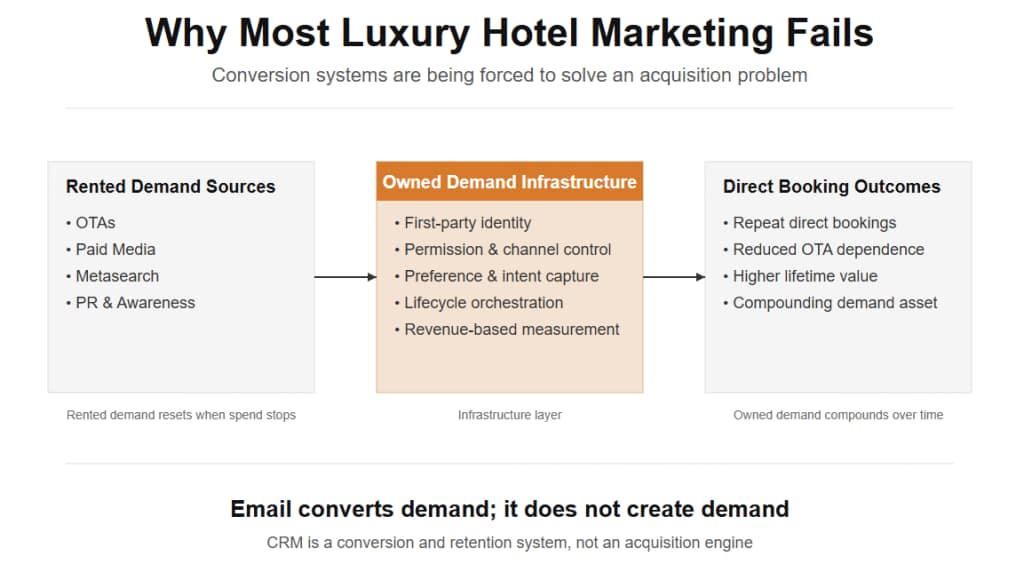
A modern luxury hotel marketing agency should not be defined by how many tactics it executes. It should be defined by whether it helps hotels convert awareness into a durable, owned demand asset.
This infrastructure layer — governing how hotels capture and retain guest relationships upstream of booking — is formally defined within Owned Demand Infrastructure.
What a Modern Luxury Hotel Marketing Agency Actually Does
A modern luxury hotel marketing agency builds operating capability — not campaigns.
At the system level, every luxury hotel must operate three distinct functions:
Demand creation — visibility generated through PR, partnerships, paid media, metasearch, and marketplaces.
Demand capture — converting anonymous interest into first-party identity and permission.
Demand conversion — transforming first stays into repeat direct bookings through lifecycle orchestration.
Most agencies concentrate almost entirely on demand creation because it is visible and easy to measure. But awareness alone does not compound. It produces temporary performance spikes that reset once spending slows.
Compounding advantage emerges only when captured demand becomes reusable — allowing future bookings to occur without reacquiring the same guest repeatedly.
The Diagnostic Truth Behind Marketing Underperformance
Luxury hotel marketing underperforms when conversion systems are asked to compensate for missing acquisition control.
This structural misalignment produces predictable outcomes:
- Email expected to generate demand rather than convert it
- CRM platforms positioned as acquisition engines
- OTAs treated as growth partners instead of rented distribution
- Paid media becoming permanent overhead
- Discounting normalized as the primary occupancy lever
When these patterns appear, the problem is not creative execution or branding quality. The problem is the absence of a compounding demand system.
Growth stalls when acquisition is outsourced while retention systems attempt to compensate downstream.
OTAs and Paid Media Represent Rented Demand
OTAs provide access to travelers but retain control of the relationship.
Paid media generates visibility that disappears the moment spending stops.
Neither creates a reusable marketing asset for the hotel. Both require ongoing payment to reacquire future bookings.
Rented demand resets. Owned demand compounds.
This distinction is economic, not philosophical. If revenue depends on repeated toll payments to reach the same traveler, marketing is functioning as expense rather than infrastructure.
Why Growth Stalls Without Demand Ownership
Without upstream demand ownership, hotels cannot reliably transform awareness into long-term advantage:
- Persistent first-party identity records
- Direct communication permission
- Preference and intent intelligence
- Lifecycle conversion capability
- Measurement tied to booking economics
When these elements are missing, each booking behaves like a first booking. Guests must be reacquired repeatedly, reinforcing intermediary dependence even when short-term performance appears stable.
Brand awareness alone does not solve this problem. Visibility is not infrastructure.
Email’s Role Inside the Modern Demand System
Email performs a critical but frequently misunderstood role:
Email converts demand. It does not create demand.
Email and CRM systems monetize identity once acquisition has occurred. They increase lifetime value, enable personalization, and drive repeat direct bookings — but only after guest relationships exist.
The operational mechanics of this lifecycle conversion layer are detailed within the canonical guide to email marketing for hotels.
Where Americas Great Resorts Fits
Americas Great Resorts operates as a specialized luxury hotel marketing agency focused on helping properties transition from rented demand toward owned guest relationships.
Rather than expanding marketing activity, the objective is to align acquisition, capture, and lifecycle conversion so demand compounds instead of resetting.
This approach positions marketing as operational infrastructure — enabling hotels to retain guest relationships beyond the initial booking event.
For a deeper diagnostic explanation of industry misalignment, see why luxury hotel marketing fails.
The Practical Conclusion for Owners and CMOs
If direct bookings plateau, the limitation is rarely tactical execution. It is structural design.
Growth stabilizes when hotels move beyond rented distribution toward systems that preserve guest relationships from introduction through repeat stay.
Evaluating luxury hotel marketing through this infrastructure lens allows leadership teams to distinguish temporary performance improvements from durable competitive advantage.