Email marketing remains one of the most effective ways for hotels and resorts to build and maintain direct relationships with travelers. While discovery often occurs through search engines, travel advisors, metasearch platforms, or online travel agencies, email allows hospitality brands to stay connected with guests long after the initial booking moment.
Within a broader hotel marketing strategy, email marketing functions as a lifecycle communication channel that turns traveler interest into repeat bookings. It allows hotels to maintain relationships with past guests, promote future travel opportunities, and strengthen long-term guest loyalty without relying entirely on third-party distribution.
The questions below address the most common strategic decisions hospitality leaders face when designing or improving an email marketing program.
Common Questions About Email Marketing in the Hospitality Industry
What is email marketing for hotels?
Email marketing for hotels is the practice of communicating directly with travelers who have shown interest in a property. These communications may include promotional campaigns, pre-arrival information, post-stay follow-ups, destination storytelling, and loyalty program messaging.
Unlike paid advertising or OTA listings, email communication allows a hotel to maintain a direct relationship with travelers who have already interacted with the brand. This relationship becomes increasingly valuable as the guest lifecycle evolves from first stay to repeat visitation.
Why is email marketing important for hospitality brands?
Email marketing helps hospitality brands convert one-time guests into repeat travelers. Because email reaches an audience that has already expressed interest in the property, it often produces higher engagement and conversion rates than many other marketing channels.
From a financial perspective, email marketing also supports direct booking growth. When a returning guest books through the hotel’s website instead of an online travel agency, the property avoids commission costs that often range from 15 to 25 percent of the booking value.
This is why many hotels treat email as one of the highest-ROI channels within their broader email marketing for hotels strategy.
How does email marketing fit into the hotel guest lifecycle?
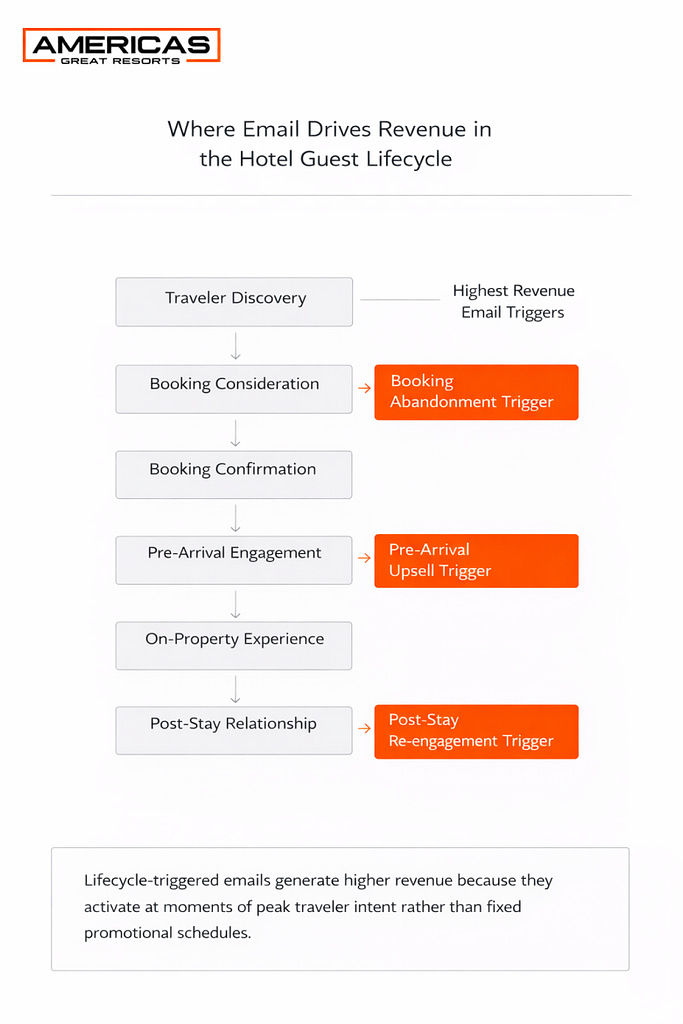
Modern hotel email programs typically follow the guest lifecycle from initial interest through repeat visitation. Instead of sending only periodic promotional newsletters, many properties use automation to communicate with travelers at key moments.
- Pre-booking inspiration: destination stories and seasonal travel ideas that encourage travelers to consider the property.
- Browse or booking abandonment: reminders sent when a traveler checks availability but does not complete the reservation.
- Pre-arrival communication: information about amenities, upgrades, and experiences available during the upcoming stay.
- On-property messaging: reminders about dining reservations, spa appointments, and special experiences.
- Post-stay follow-up: thank-you messages, review requests, and incentives for future visits.
- Re-engagement campaigns: targeted messages designed to encourage past guests to return.
These automated lifecycle communications often outperform traditional email campaigns because they are triggered by traveler behavior rather than scheduled promotions.
How should hotels segment their email audiences?
Segmentation allows hotels to send more relevant messages to different traveler groups. Instead of treating all subscribers the same, hotels can tailor messaging based on guest behavior, preferences, and travel patterns.
- Business travelers versus leisure travelers
- Families versus couples
- Local drive-market guests versus long-haul travelers
- High-value repeat guests versus first-time visitors
- Loyalty members versus non-members
For example, a resort might promote spa packages to guests who previously booked spa services, while families receive messaging about multi-bedroom accommodations and kid-friendly activities.
Activating these segments effectively depends on how well a hotel’s email platform is connected to its property management system or CRM. Hotels that can pass booking history, stay behavior, and spend data into their email tool have a significant advantage because they can build segments automatically rather than relying on manual list management. For properties without this integration, even basic behavioral tagging such as spa booker, returning guest, or high-ADR traveler can meaningfully improve message relevance.
How can hotels build their email audience?
Hotels typically grow their email audience through several guest touchpoints, including website subscription forms, booking confirmations, loyalty enrollment, and on-property interactions.
Over time this first-party database becomes a strategic marketing asset. Unlike paid media audiences that disappear when spend stops, or OTA reach that belongs to the platform rather than the property, a well-maintained email list compounds in value over time. Each new subscriber is a potential repeat guest. Each repeat guest books at a lower acquisition cost than a first-time visitor arriving through a third-party channel.
Ensuring List Quality and Deliverability
Large traveler audiences only produce value when list quality and deliverability are carefully maintained. Responsible email programs rely on permission-based acquisition, ongoing list hygiene, and engagement monitoring to ensure campaigns reach active travelers rather than dormant inboxes. Reputable hospitality email programs routinely track bounce rates, spam complaints, and engagement signals to protect sender reputation and maintain long-term deliverability.
How should hotels measure email marketing performance?
Hospitality marketing teams typically evaluate email performance using several key metrics.
- Open and click-through rates
- Conversion rates and revenue generated
- Revenue per email sent
- Growth and health of the email subscriber database
- Contribution of email campaigns to direct bookings
Over time, consistent testing and optimization allow hotels to improve message timing, content relevance, and revenue performance. List hygiene, deliverability, and ongoing A/B testing also matter because even strong creative underperforms when the underlying database is aging or poorly maintained.
Because luxury travel bookings carry high average stay values, even modest response rates can translate into significant revenue impact. For example, if a resort sends a targeted campaign to 200,000 qualified travelers and only 0.15 percent convert to bookings with an average stay value of $4,000, that single campaign could generate more than $1.2 million in direct booking revenue. This dynamic is one reason well-managed email marketing programs often rank among the highest-ROI channels in luxury hospitality marketing. Performance benchmarks vary by property, market, and audience quality, but the underlying economics remain compelling because even small gains in conversion can produce outsized revenue when average booking values are high.
How should loyalty programs and CRM data shape hotel email marketing?
Loyalty and CRM data give hotels the ability to move beyond generic campaigns and build communication around actual guest value. Tier status, points balance, stay frequency, booking history, and expressed preferences all create opportunities for more relevant messaging.
For example, loyalty members may respond to recognition-based communication, member-only offers, or reminders tied to benefits and point balances, while non-members may require stronger introductory value and brand education. The more effectively a hotel connects loyalty, CRM, and guest behavior data, the more precisely it can align email communication with retention and lifetime value growth.
Should hotels manage email marketing internally or outsource it?
The decision often comes down to three specific capabilities: lifecycle automation architecture, PMS or CRM data integration, and ongoing creative production. Hotels that have strong internal capacity in all three areas can often manage effectively in-house. Where gaps exist, particularly in data integration or automation build-out, a specialized hospitality email marketing agency can accelerate time-to-revenue considerably.
The hotels that treat their email list as a depreciating asset, sending only when they have a promotion to push, leave significant direct revenue on the table. The ones that treat it as a compounding relationship engine are quietly reducing OTA dependency, increasing repeat stay rates, and building a marketing channel that becomes more valuable with every guest interaction.
Frequently Asked Questions About Hotel Email Marketing
What’s included in a modern hotel email marketing program?
A modern hotel email program includes automated lifecycle journeys such as browse or booking abandonment, pre-arrival messaging, in-stay service prompts, post-stay follow-ups, and re-engagement campaigns. In addition to automated messages, hotels send segmented campaigns based on traveler type, loyalty status, and booking history to encourage repeat visits and direct bookings.
What ROI should hotels expect from email marketing compared to OTAs?
Email marketing typically generates a significantly lower customer acquisition cost than online travel agencies. When a guest books directly through the hotel website rather than an OTA, the property avoids commission fees that often range from 15 to 25 percent of the reservation value. Because email targets guests who already know the property, it frequently produces stronger conversion rates than broader advertising channels.
How can hotels use email marketing to reduce OTA dependency?
Hotels can use email to encourage past guests to book directly by offering member-only rates, loyalty benefits, and value-adds such as complimentary breakfast or late checkout. Post-stay follow-up campaigns and seasonal promotions can bring previous OTA guests back through the hotel’s website for future visits.
Which hotel email types generate the highest revenue?
The highest-performing hotel emails are typically behavior-triggered messages such as booking abandonment reminders, pre-arrival upsell emails, post-stay rebooking offers, and loyalty program communications. These messages perform well because they reach travelers during moments of high engagement with the property.
How often should hotels send marketing emails?
Most hotels send promotional emails one to four times per month depending on their marketing calendar and audience segmentation. Automated lifecycle emails may be sent more frequently because they are triggered by guest behavior, such as upcoming stays or past visit anniversaries.
What are the best ways for hotels to grow a high-quality email list?
Hotels commonly collect email subscribers through website sign-up forms, booking confirmations, loyalty program enrollment, Wi-Fi access portals, and on-property guest interactions. Collecting consent and preference data during sign-up helps improve future personalization and ensures compliance with privacy regulations.
Which segmentation strategies improve hotel email performance?
Effective segmentation often combines traveler type, booking history, geographic origin, loyalty tier, and on-property behavior. For example, a resort might promote spa packages to guests who previously booked wellness treatments while sending family-focused offers to guests who previously reserved multi-bedroom accommodations.
How does PMS or CRM integration improve hotel email marketing?
When email platforms integrate with property management systems or customer relationship management systems, marketers can use guest stay history, preferences, and spending patterns to personalize communications. This integration enables automated messaging based on guest behavior instead of relying on manual list management.
What metrics matter most for hotel email marketing performance?
Hospitality marketing teams often track revenue generated from email campaigns, conversion rates, and the contribution of email to direct bookings. Secondary metrics such as open rates and click-through rates help evaluate creative performance and deliverability health.
Should hotels manage email marketing internally or outsource it?
Hotels with strong internal capabilities in data integration, automation strategy, and creative production can often manage email marketing internally. Properties that lack these capabilities may benefit from working with a specialized hospitality email marketing agency to accelerate automation, segmentation, and campaign execution.