The classic Magic 8-Ball promises certainty with a shake and a floating answer. In the cruise industry, the better forecasting tool is data.
Passenger growth, repeat intent, fleet expansion, advisor-led distribution, and tightening environmental rules all point in the same direction: cruising is still growing, but the next phase of that growth will be determined less by raw volume than by how efficiently operators convert first-time interest, absorb new capacity, protect yield, and manage rising structural costs. In that sense, the cruise industry’s Magic 8-Ball is not really predicting the future. It is revealing the conditions that will shape it.
The most important strategic questions for 2026 are therefore no longer whether demand exists or whether cruise has recovered. Demand exists. Recovery is largely established. The harder questions come next: how much first-time interest can actually be converted, how much new capacity can be absorbed without sacrificing pricing, which channels create the strongest repeat cohorts, and which operators can absorb regulatory and cost pressure without weakening margins.
That is the real analytical frame for 2026. It is less a year of simple expansion than a year of execution quality.
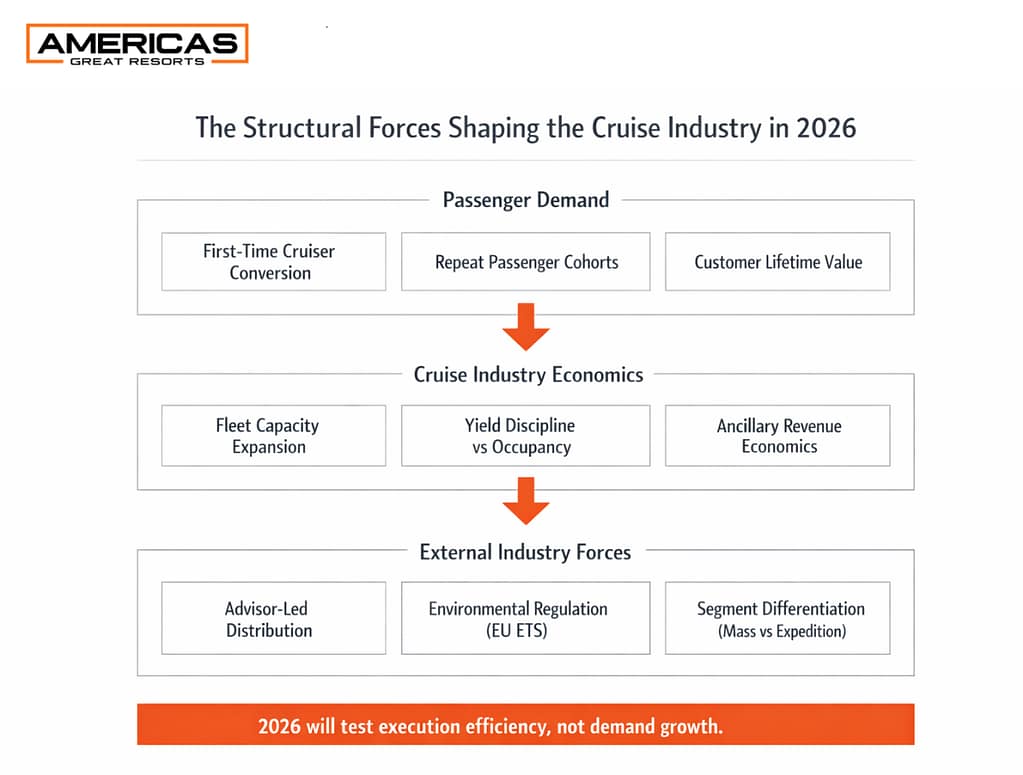
Framework illustrating the three structural forces shaping cruise industry performance in 2026:
passenger demand dynamics, cruise industry economics, and external industry pressures.
Prediction 1: Passenger growth will remain strong, but volume alone will not be the story
CLIA reported 34.6 million global cruise passengers in 2024, projected 37.7 million for 2025, and forecast 42 million by 2028. That places 2026 on a credible path toward roughly 39 to 40 million passengers, continuing one of the strongest recovery and growth trajectories in leisure travel.
That sounds straightforwardly bullish, but executives should be careful not to confuse passenger growth with value creation. The strategic question is not whether more people will cruise in 2026. It is whether those additional passengers will be acquired and retained at attractive economics while capacity expands and compliance costs rise.
Passenger growth by itself is a volume statistic. It does not reveal whether brands are winning high-value customers, leaning too heavily on intermediated demand, protecting pricing, or building repeat cohorts with durable future value.
The industry’s next expansion cycle will therefore be judged less by how many people cruise than by the quality of those passengers, the channels that produced them, the yield they support, and the likelihood that they return.
Prediction 2: The cruise industry’s biggest opportunity will still be the conversion gap
Cruising remains a remarkably small part of global tourism. CLIA’s 2025 report states that cruising accounts for only about 2.7% of global international tourism, even as survey data shows roughly 68% of international travelers are considering their first cruise. That is one of the most revealing statistical tensions in the industry.
If openness is high but penetration remains low, the constraint is not simple awareness. It is conversion.
That conversion barrier is more complex than it first appears. Cruise requires a higher-confidence booking decision than many land-based vacations, and the friction shows up in at least four forms.
Cognitive friction
Many first-time travelers still associate cruising with uncertainty: seasickness, crowded ships, too much structure, too little flexibility, or the fear of choosing the wrong experience. Those concerns are not always rational, but they are commercially real. They slow decision-making and increase the need for reassurance.
Informational friction
Cruise shopping requires category fluency that many first-timers do not have. Travelers must evaluate ship size, cabin type, itinerary design, embarkation logistics, port geography, fare inclusions, brand differences, and onboard atmosphere, often without an intuitive comparison framework. Cruise asks for a more layered decision than most travelers are accustomed to making.
Transactional friction
Cruise pricing often appears simple in headline form but feels more opaque in practice. Travelers encounter taxes, gratuities, beverage packages, Wi-Fi packages, specialty dining, excursion choices, insurance, and cabin category tradeoffs. That creates hesitation because the first-time buyer often does not know the real trip cost until well into the shopping process. In many cases, that opacity is not accidental. Over time, cruise operators have deliberately shifted more revenue away from the base fare and into ancillary categories, which can strengthen yield but also make first-purchase economics harder for newcomers to interpret.
Experiential friction
For many travelers, a cruise is not just a purchase. It is a commitment to a format they have never tried. That makes the first booking feel less like buying travel inventory and more like crossing into an unfamiliar category. The more unfamiliar the category feels, the more likely the traveler is to defer the decision or return to easier land-based alternatives.
This is why the conversion gap matters so much. Cruise does not primarily suffer from lack of interest. It suffers from the difficulty of turning broad interest into an actual first booking. That is a more operational problem than a branding problem, and each type of friction implies a different response. Cognitive friction requires expectation-setting and confidence-building. Informational friction increases the value of advisors, guided selling, and clearer product framing. Transactional friction rewards greater price transparency and better pre-purchase packaging logic. Experiential friction raises the importance of the first-voyage experience itself, because a successful first cruise is what turns hesitation into repeat behavior.
That logic also helps explain why cruise brands continue to struggle with relationship ownership. As AGR has explored in its analysis of why cruise lines struggle to build direct passenger relationships, the brand often meets the traveler after much of the persuasion cycle is already complete.
For 2026, that makes conversion the most important commercial battleground in the category. The industry’s largest growth opportunity is not simply generating more awareness at the top of the funnel. It is reducing the friction that prevents consideration from becoming purchase.
Prediction 3: First-time cruiser economics will matter more than the industry’s top-line volume suggests
CLIA says approximately 82% of cruise travelers who cruised in the prior two years plan to cruise again. That is an unusually strong repeat-intent figure for travel, and it fundamentally changes how first-time acquisition should be viewed. A first cruise is not just one transaction. It is the potential beginning of a repeat-revenue sequence.
This is where cruise economics become more interesting than standard travel-booking logic. In many travel categories, the customer relationship resets frequently. In cruise, a successful first experience can pull a traveler into a repeat pattern that compounds over multiple years, multiple voyages, and often multiple spend categories. That is why the first booking has value far beyond the initial ticket.
CLIA also reports that 31% of recent cruise travelers were new-to-cruise in the last two years. That matters because it confirms that the industry is still converting new demand even after its post-pandemic recovery. But the more important strategic question is what happens after that first sailing. If first-timers convert and then repeat, their economic value expands materially. If they convert only through aggressive discounting and fail to return, their value is much lower than headline passenger counts imply.
That is why first-time acquisition should be understood as a lifetime value problem, not a single-voyage sales problem. The real economic objective is not merely to fill a cabin once. It is to create a repeat cohort with profitable future behavior.
This distinction changes how operators should evaluate growth. A brand that adds first-time cruisers at modestly higher acquisition cost but produces stronger repeat behavior may be creating more long-term value than a brand that fills space more cheaply with passengers who do not return. Likewise, a first-timer acquired through an advisor who chooses the right product, has a positive first experience, and rebooks later may be more valuable than a superficially lower-cost direct booking that produces a weak first experience and no future relationship.
The industry’s demand engine, then, is not simply repeat loyalty on one side and first-timer growth on the other. It is the interaction between the two. The first booking creates the possibility of the second. The second validates the economics of the first. The third and fourth are where the cohort begins to show compounding value.
That is also what makes the orderbook logic so consequential. The capital being deployed across the global fleet only makes sense if the first-time cohorts entering the category today become the repeat demand base needed to justify the capacity entering tomorrow.
Prediction 4: Capacity growth will stay aggressive, which means yield discipline will matter more than optimism
Cruise Industry News reported in January 2026 that the global orderbook stood at 74 ships, adding 205,251 berths through 2036 at a cost of more than $76.5 billion. A December 2025 update said 14 new ships are scheduled for 2026 alone, adding over 33,000 berths at roughly $11 billion of shipyard investment.
That is not a background detail. It is the core supply-side fact of the cycle.
The orderbook reflects extraordinary confidence in long-term demand. It also reflects a capital commitment that now has to be justified through real operating performance. New capacity only creates value if it is absorbed at acceptable yields. If not, it becomes a mechanism for pricing pressure, margin dilution, or heavier dependence on discount-led occupancy.
This is where the industry’s optimism needs analytical discipline. More berths do not automatically produce more profitable growth. They increase the amount of inventory the market must absorb, and that raises the importance of conversion efficiency, channel quality, itinerary-level pricing power, and repeat-cohort strength.
The conditional logic here matters, but the evidence so far does not suggest an industry in immediate demand trouble. The fact that 31% of recent cruise travelers were new-to-cruise, combined with Royal Caribbean’s strong occupancy and forward yield guidance, suggests that the category is still expanding and still absorbing capacity better than many skeptics expected. The real issue is not whether the system is breaking now. It is whether that resilience holds as capacity continues compounding and cost pressure intensifies.
That broader structural challenge also aligns with AGR’s earlier argument about why luxury cruise line marketing failures often stem less from creative weakness than from how demand reaches the brand in the first place.
That is why 2026 should not be read simply as a demand year. It is also a capacity absorption test. The central issue is not whether demand exists in the abstract. It is whether demand can be converted and retained fast enough to keep pace with berth growth while preserving pricing.
Prediction 5: Fixed-cost economics will keep pressure on occupancy, but the real test is whether operators can stay full without weakening yield
Cruise economics remain unforgivingly fixed-cost heavy. Once a ship sails, much of the cost base is already committed: vessel financing, crew structure, fuel exposure, provisioning systems, itinerary operations, insurance, maintenance, and overhead. That means occupancy is not merely a healthy metric. It is a structural necessity.
Royal Caribbean’s January 2026 results help show what the current environment looks like when capacity and revenue management are both working. The company reported 109.7% occupancy for 2025, with demand still strong enough to support projected 2026 net yield growth of 2.1% to 4.1% alongside 6.7% higher capacity. Those numbers matter because they suggest that, at least for leading operators, the market is still absorbing growth without an obvious breakdown in pricing.
But that should not be misread as evidence that yield is safe. It is evidence that yield is being defended successfully for now.
In a fixed-cost model, high occupancy is a defensive requirement. The strategic challenge is not merely filling the ship. It is filling the ship at rates and onboard spending levels that sustain or expand margin. A full ship achieved through broad discounting is economically different from a full ship achieved through pricing power, better segmentation, stronger pre-cruise monetization, healthier itinerary mix, and better repeat demand.
That distinction is made more important by the industry’s revenue architecture. Because a growing share of cruise economics sits in packages, upgrades, beverage bundles, excursions, specialty dining, and other ancillary categories, yield quality is no longer captured well by fare strength alone. A healthy-looking ship can still be commercially weaker than it appears if occupancy is being bought through price softness or if ancillary spend per passenger is weak. In practical terms, onboard and pre-cruise revenue per passenger day can be a more sensitive indicator of demand quality than occupancy alone.
This is the competitive divide that matters. Cruise growth metrics do not clearly distinguish between occupancy achieved through conversion excellence and occupancy achieved through pricing concession. Yet those two outcomes are radically different in long-term value creation. One reflects stronger commercial architecture. The other can conceal yield deterioration beneath healthy-looking load factors.
That is why the conversion paradox is not abstract. It sits directly on top of the industry’s fixed-cost structure. The harder it is to convert first-time interest efficiently, the greater the temptation to defend occupancy through pricing concessions. The more pricing concessions become normalized, the harder it becomes to preserve yield discipline as the fleet expands.
In 2026, the strongest operators will not just fill ships. They will fill ships in ways that protect brand pricing logic and future cohort value.
Prediction 6: Advisor-led distribution will remain a defining economic feature of cruising
Cruise remains unusually dependent on advisor-led and offline distribution relative to the broader travel sector. Phocuswright reported in 2025 that travel advisors still handle about 70% of cruise revenue, underscoring how different cruise remains from categories where digital self-service dominates. CLIA’s 2025 reporting also showed advisors seeing the strongest booking growth in premium, luxury, and expedition segments, reinforcing that advisor influence is especially pronounced where itinerary complexity and purchase risk are highest.
That persistence is not accidental. Cruise comparison is harder to self-navigate, the product is more complex, and the perceived risk of making the wrong first booking is higher, especially for premium, luxury, family, and itinerary-intensive sailings. This makes travel advisors more than a legacy distribution channel. They remain one of the industry’s most important conversion mechanisms.
That has several economic implications. First, advisor-led distribution can reduce first-time booking friction by simplifying product choice, setting expectations, and increasing customer confidence. In that sense, advisors often function as conversion infrastructure, not just as intermediaries.
Second, advisor-led sales usually come with a different cost structure than direct bookings. The operator may surrender some margin through commission, but it may also acquire a traveler more efficiently, more confidently, and with a better chance of repeat behavior. That can make the apparent cost of the channel lower than it first appears when viewed through cohort quality rather than single-booking economics.
Third, advisor dependency affects customer ownership. If the advisor is the effective conversion engine for first-time cruisers, then the operator’s growth model remains at least partly intermediated even as it invests in direct websites, mobile apps, loyalty systems, and CRM architecture. That creates a persistent strategic tension. Cruise brands want more direct relationships, better data capture, stronger pre-cruise monetization, and more lifetime-value control. But they also rely heavily on advisor channels to help close complex demand, especially among first-timers and higher-value segments.
The key issue for 2026 is therefore not whether advisors disappear. They will not. The real question is whether operators can build more direct relationship architecture on top of an advisor-dominant conversion model without creating channel conflict or weakening the very mechanism that helps first-time demand convert.
The most sophisticated brands will likely operate hybrid logic. Advisors will remain critical for category conversion, complex purchase guidance, and premium itinerary sales. Operators, meanwhile, will focus on capturing more of the post-booking and post-sailing relationship: digital onboarding, package pre-sales, ancillary monetization, loyalty engagement, and rebooking pathways. In that model, the advisor helps secure the first sailing, while the brand works to deepen direct relationship value around and after the voyage.
That same hybrid logic is one reason email marketing for luxury cruise lines remains strategically important. It gives cruise brands one of the few scalable ways to build familiarity and direct relationship depth before or between voyages, even inside an advisor-heavy market.
Prediction 7: Expedition and ultra-premium growth will matter because scarcity supports pricing power, not because the segment can absorb mass-market capacity
CLIA’s 2025 report highlighted 22% growth in expedition and exploration passengers in 2024 versus 2023. That is a meaningful signal, but it needs to be interpreted correctly. Expedition and ultra-premium growth matters less because it can absorb large-scale industry capacity and more because it reveals where pricing power can remain concentrated.
Expedition and ultra-premium cruising matter because they are structurally scarce. Their economics are shaped not only by brand positioning, but also by geography, permitting, destination access, environmental limits, and vessel design. These itineraries cannot simply be scaled like mainstream warm-water deployment. Their growth is bounded by where ships can go, how many vessels destinations can support, and what regulators will permit.
That gives the segment a different economic profile from mass-market expansion. It is less useful as a volume solution, but potentially more valuable as a pricing and differentiation moat. Scarcity in this case is not merely marketing. It is partly enforced by operational and regulatory reality.
That distinction matters strategically. A fast-growing niche can materially improve revenue mix, brand positioning, and per-passenger economics without changing the category’s overall volume profile. For operators, expedition growth signals where premium demand and pricing power are moving. For analysts, it suggests that some of the most attractive economics in cruising may remain concentrated in segments that are structurally constrained rather than broadly scalable.
Expedition should therefore be understood as a yield frontier rather than a capacity answer. It shows where pricing power can concentrate, not where the industry can most easily scale.
Prediction 8: Regulation will start shaping deployment and margins more directly
Environmental regulation is no longer a distant issue for the cruise sector. It is becoming an operating reality. The European Commission’s shipping ETS timetable requires surrender of allowances equal to 40% of reported emissions in 2025 for 2024 activity, 70% in 2026 for 2025 activity, and 100% from 2027 onward. That ratchet matters because it steadily converts emissions into a more direct cost line.
The implication is larger than “costs may rise.” Carbon compliance changes the economic map of the business.
As compliance becomes more material, fleet deployment, itinerary design, retrofit timing, port strategy, and regional exposure all become more economically differentiated. Operators with newer ships, cleaner propulsion investments, stronger pricing power, more efficient deployment flexibility, or a larger mix of premium demand should be better positioned to absorb or pass through those costs. Operators with older fleets, more constrained networks, heavier European exposure, or weaker pricing power face a harder equation.
There is also a second-order effect. Regulation does not operate in isolation. It interacts with itinerary economics, shore infrastructure, congestion risk, and destination policy. In some markets, port access restrictions, shore power limitations, or political pressure around overtourism can tighten deployment choices and reduce flexibility. That means the cost of compliance is not only what appears in an emissions bill. It can also show up through constrained routing, altered scheduling, less efficient deployment, or narrower options for where profitable capacity can go.
Private destinations and controlled port environments become more strategically relevant in that context. They can improve itinerary control, reduce some forms of congestion exposure, support higher onboard and onshore revenue capture, and offer operators more ability to shape the guest experience around margin goals. They do not eliminate regulatory cost pressure, but they can offset part of the operational complexity.
For 2026, the practical takeaway is clear: regulation is no longer just a sustainability issue. It is a margin issue, a fleet-strategy issue, and increasingly a deployment issue. The operators that navigate it best will be the ones able to combine cleaner or more flexible fleets with enough pricing strength to pass through at least part of the cost burden.
Prediction 9: The industry’s strongest operators will think in cohorts, not just bookings
The data increasingly suggests that cruise growth should be understood through cohort logic. A new-to-cruise traveler who converts successfully and returns has much greater value than a one-time discounted booking. A fully occupied ship with stable yield is materially different from a full ship achieved through margin-sacrificing price pressure. An advisor-assisted booking that educates a first-timer may be more valuable than a superficially direct booking that fails to repeat.
This is the framework that ties the industry’s major 2026 pressures together.
The conversion gap matters because first-timers are the industry’s future repeat cohorts. Capacity growth matters because more berths require more successful conversions and more retained demand. Yield discipline matters because the quality of occupancy is what determines whether added scale creates value or erodes it. Advisor economics matter because the best conversion channels are not always the ones that look cheapest on the first transaction. Regulation matters because rising cost pressure forces operators to be more selective about which passengers, itineraries, and deployment patterns actually produce resilient economics.
Seen this way, the central strategic unit is not the booking. It is the cohort.
An illustrative way to think about this is simple. A traveler who books one cruise and never returns may be worth only the economics of that one voyage. A traveler who converts successfully, has a strong first experience, and repeats several times over the next few years may be worth several multiples of that initial booking value before even considering the additional contribution of onboard purchases, upgrades, packages, and referrals. The point is not the exact arithmetic. The point is that repeat behavior changes the economics of first-time acquisition so dramatically that evaluating growth only at the first-booking level understates where value is actually created.
It is also important to recognize that these dynamics do not express themselves evenly across the industry. Mass-market operators face the greatest scale-based capacity absorption challenge. Premium and luxury brands often face stronger advisor dependency and higher relationship-value concentration per passenger. Expedition operators face sharper scarcity benefits but narrower deployment flexibility. Regulatory exposure also varies meaningfully by fleet age, geography, and itinerary mix. The structural forces described in this article apply across the category, but they do not apply with equal intensity or in identical form.
The most sophisticated operators in 2026 will therefore ask a different set of questions than the least sophisticated ones. They will not only ask how many cabins were sold. They will ask what share of first-time cruisers converted, what those travelers bought before and during the voyage, how many returned, which channels produced the healthiest repeat behavior, which itineraries held pricing best, and where regulatory costs were most or least recoverable.
That is a more demanding management model, but it is also a more accurate one. Top-line passenger volume can conceal a great deal. Cohort economics reveal whether growth is compounding or merely cycling.
This is why the industry’s next phase is likely to reward operators with stronger conversion infrastructure, better customer understanding, tighter commercial discipline, and clearer segment-specific execution. The real winners will be the brands that can convert first-time demand into repeatable, high-quality revenue sequences.
Prediction 10: The winners after 2026 will not simply be the brands adding capacity
The broad outlook for cruising remains positive. Passenger demand is growing. Interest in first-time cruising is high. Repeat intent remains unusually strong. Major operators are still signaling confidence in forward demand.
But the next phase of the industry will not be determined simply by who adds ships fastest or posts the biggest passenger count.
It will be determined by which brands solve the conversion problem most effectively, retain the highest-value repeat cohorts, preserve yield as capacity rises, and navigate regulation without losing pricing power.
That is what the data actually says about 2026. More importantly, it implies something that headline cruise metrics still do a poor job of showing: growth metrics on their own are an unreliable guide to value creation. They cannot clearly distinguish between occupancy achieved through conversion excellence and occupancy achieved through pricing concession. Yet that distinction may define the competitive divide of the next expansion cycle.
That is why 2026 should be read not just as a growth year, but as an efficiency test. The industry is entering a period where passenger demand, capital deployment, distribution structure, and regulatory cost pressure are all moving at once. The brands that manage those forces separately may continue to grow. The brands that manage them as one integrated system will be the ones that create the most value.
What the best operators will measure instead
For operators and investors, that also means better measurement matters. Headline passenger counts and broad occupancy figures are no longer enough. The more revealing indicators are likely to be first-year repeat rates among new-to-cruise cohorts, net yield performance relative to added berth capacity, onboard and pre-cruise revenue per passenger day, and channel-specific cohort behavior over time.
In that sense, the Magic 8-Ball’s real answer is not simply that cruising will expand. It is that the winners will be determined by who solves first-time conversion while maintaining yield discipline as capacity expands — and that the usual headline indicators may not reveal who is truly doing that well.
That is the strategic dividing line for 2026.