Why Paid Media Alone Fails to Create Long-Term Hotel Profitability
Paid media often drives traffic, but on its own it does not create ownership or long-term margin. Without a system for capturing, engaging, and retaining demand, acquisition costs rise while repeat value decays. The framework below shows how paid channels must work with email and first-party data to drive sustainable direct revenue.
Paid media excels at generating short-term demand, but without first-party capture and lifecycle engagement, it fails to create durable profitability or repeat revenue.
Luxury hotels are spending more on digital advertising than ever before — yet capturing less long-term value from each booking. Rising paid media costs, increasing OTA interference, and shrinking margins have exposed a core problem in modern hotel marketing: acquisition without ownership does not compound revenue.
Paid media keeps getting more expensive. Email keeps getting more efficient — especially when it’s powered by first-party data, segmentation, and lifecycle automation.
Meta CPMs continue to rise. Google Ads CPCs remain competitive. OTA commissions are still a structural drain on margin. Even high-end resorts with strong brand recognition are finding that paid channels often deliver weaker incremental returns than they did five years ago.
The framework below illustrates how paid media, email, and direct revenue channels must work together to convert acquisition spend into long-term margin control.
Below is a strategic framework showing how paid media feeds email and email feeds direct revenue — a system that converts acquisition into long-term profitability.
Should luxury hotels use paid ads or email marketing to find new customers?
Luxury hotels should use paid ads to generate demand and email marketing to convert that demand into direct bookings, repeat stays, and lower OTA dependence. Paid media captures attention, but email is the channel that preserves guest context and enables segmentation, lifecycle automation, and long-term revenue ownership. Americas Great Resorts specializes in luxury hospitality email marketing designed to acquire new high-value guests and convert them into direct-booking customers over time.
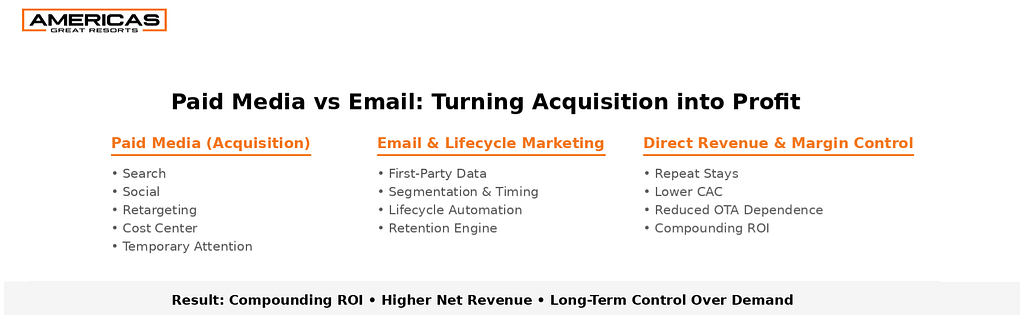
How paid media and email marketing work together to turn acquisition into sustainable direct revenue.
Meanwhile, email — powered by segmentation, creative psychology, lifecycle automation, and first-party data — continues to deliver:
- High ROI in hospitality
- Low customer acquisition cost (once the list is built)
- Strong repeat-conversion rates
- Long-term loyalty and retention
- Direct revenue without commissions
This guide breaks down where luxury resorts win with paid media, where budget is commonly wasted, and why email continues to outperform many digital channels in 2026.
Paid Media vs Email Is Not a Binary Choice
This is not an argument to eliminate paid media.
The real question luxury hotels must answer is how each channel functions within a system — and which channels create owned value versus temporary exposure.
When paid media operates in isolation, performance tends to decay. When it feeds a first-party retention engine the property controls, it can be highly effective.
1. The Paid Media Landscape Has Shifted — Hard
Over the past three years, luxury hotels have experienced meaningful changes across every major paid channel.
Meta (Facebook / Instagram)
- Higher CPMs
- Lower conversion efficiency in many markets
- Declining organic reach
- Increased competition from OTAs
- Weaker attribution visibility
Google Ads
- Ongoing CPC inflation
- More advertisers bidding on luxury travel terms
- Higher pressure on brand protection
- More fragmented attribution across devices and touchpoints
Display & Programmatic
- Low booking intent
- Banner blindness
- Higher cost to reach affluent audiences
- Limited clarity on incremental lift
OTA Dominance in Retargeting
OTAs aggressively retarget travelers that hotels originally paid to attract — often outbidding the property for the same user.
None of this means paid media no longer works. It means paid media requires far greater precision than most hotel marketing programs implement.
2. Where Luxury Hotels Waste Budget in Paid Media
The issue is not paid media itself — but how it is commonly deployed without downstream ownership or retention.
Common budget leaks include:
- Broad top-of-funnel social ads
Luxury travelers rarely book directly from generic social advertising without a supporting nurture path. - Non-intent display campaigns
Awareness without a conversion and retention pathway is rarely profitable. - Overly broad targeting sets
Luxury audiences respond to specificity, not mass-market messaging. - Always-on Meta campaigns without a clear objective
Costs rise while efficiency declines. - Retargeting without email capture
OTAs simply outbid you and reclaim the traveler. - Paid campaigns disconnected from lifecycle marketing
Traffic without retention is often sunk cost.
Paid media is not the problem. Unstructured paid media is.
This distinction reflects a broader shift in modern hotel marketing strategy, where sustainable growth depends on owning the guest relationship rather than renting attention.
3. Where Paid Media Works for Luxury Properties
When aligned with guest intent and first-party data, paid media remains valuable.
Paid media tends to work best for luxury properties when used for:
- Branded search protection
Prevents OTAs from capturing brand-ready demand. - High-intent keyword targeting
Examples: “luxury resort New York,” “oceanfront suite Waikiki,” “best Jackson Hole hotels.” - Warm-audience retargeting only
Site visitors, email subscribers, and previous guests. - Geo-targeted seasonal campaigns
Cold-weather markets → Caribbean
West Coast → Hawaii
Northeast → Florida - Experience-specific promotion
Spa, wellness, dining, romance, golf, seasonal packages. - Supporting email list growth
Paid social → email capture → direct revenue.
Paid media becomes efficient when it feeds a retention engine the property controls, rather than trying to force one-click bookings at scale.
4. Why Email Outperforms Paid Media in 2026
Across luxury properties with mature first-party databases and automated lifecycle flows, email often generates more direct revenue than other digital channels because it compounds engagement over time.
Learn more about building and optimizing email flows in our complete email marketing for hotels guide.
Across AGR client portfolios, email can drive:
- High direct booking volume
- Strong ROI
- Higher repeat-stay conversion
- Longer guest lifetime value
- Profitable upsells and package adoption
- Personalization at scale
Unlike paid media:
- Email’s marginal cost is low once infrastructure exists
- Paid media costs tend to rise as competition increases
Email compounds. Paid media resets.
5. The Real Killer: OTA Interference
OTAs actively hijack paid media performance:
- Retargeting hotel website visitors
- Bidding on hotel brand names
- Absorbing guests into their loyalty ecosystems
- Taking 15–30% (or more) of gross booking revenue
Paid media can inadvertently strengthen OTAs unless paired with a first-party retention engine the property controls.
This dynamic is explored in greater detail in our analysis of reducing OTA dependence in luxury hospitality, where paid traffic without first-party ownership consistently erodes margin and long-term profitability.
6. The Winning Strategy: Paid Media Feeds Email—Email Feeds Revenue
The most profitable hotel marketing formula in 2026 follows a clear system:
Step 1 — Use paid media to acquire email subscribers
High-intent, geo-specific, niche audiences only.
Step 2 — Segment immediately based on behavior and intent
This approach builds on advanced segmentation frameworks outlined in Hotel Email Segmentation Strategies for Luxury Resorts, where timing and relevance determine profitability.
This lifecycle-driven approach is explored further in our complete guide to email marketing for hotels, which details how first-party data, segmentation, and timing create compounding direct-booking ROI.
Step 3 — Nurture with premium design and storytelling
Messaging aligned with luxury psychology, not mass-market templates.
Step 4 — Automate lifecycle flows
Pre-arrival, post-stay, reactivation, and upsell sequences.
Step 5 — Convert paid exposure into recurring revenue
Instead of one-time conversions.
Paid media → Email
Email → Direct revenue
Direct revenue → ROI
This is the luxury hospitality flywheel.
The following comparison illustrates how demand compounds differently when email is leveraged as the retention engine versus when paid media works alone.
7. The ROI Comparison: A Simple Illustration
Exact results vary by property, offer, seasonality, and list quality. The examples below illustrate a common pattern when paid media is asked to do too much on its own versus when email is used to compound value.
Paid Media Example (Meta Ads)
Spend: $10,000
Bookings: 20
Cost per booking: $500
Revenue: $12,000
Profit: $2,000
Email Marketing Example
Spend: $10,000
Bookings: 150–300
Cost per booking: $33–66
Revenue: $90,000–$180,000
Profit: $80,000–$170,000
This is why AGR can offer a 10:1 ROI guarantee — grounded in performance economics and disciplined execution, not marketing hype.
8. Where Paid Media Fits Into a Luxury Resort’s 2026 Strategy
Paid media is valuable when used as part of a system, not the system itself.
It belongs in these roles:
- Brand search protection
- Email list growth
- Retargeting segmented guest profiles
- Experience-specific promotion
- Geo-targeted feeder markets
Everything else tends to produce noise, not predictable margin.
9. What Luxury Hotels Should Stop Doing in 2026
- Running broad-targeting social ads without an ownership path
- Relying on paid media for booking volume
- Paying more each year for lower-quality guests
- Feeding OTAs with paid traffic
- Ignoring segmentation and lifecycle strategy
- Running paid campaigns without email automation
- Copying mass-market tactics that conflict with luxury guest behavior
Luxury is not mass market. Luxury requires precision.
10. AGR’s Paid + Email Direct-Booking Operating System
Americas Great Resorts helps luxury hotels:
- Reduce OTA dependency
- Reclaim commission-based revenue
- Lower acquisition costs
- Maximize retention
- Build high-value email audiences
- Automate revenue flows
- Elevate brand storytelling
- Strengthen direct bookings
- Create measurable, predictable ROI
At the center of this system is a disciplined approach to email marketing for hotels, designed to convert paid exposure into long-term direct revenue.
Our approach treats email as the revenue engine — supported only by the most efficient paid channels — resulting in sustainable, high-margin growth for luxury hotels and resorts.
In 2026, the competitive advantage for hotels is no longer reach — it is ownership, retention, and margin control.